Brunei looks to China to boost reforms

Foreign investment needed to drive diversification of oil-based economy
Editor's note: China Daily continues its reports from neighboring countries to provide insight into topics relevant to China. In the second installment of our four-part series, we examine Brunei's efforts to diversify its economy, which is dependent on oil and gas, and we explore China's role in the process.
China can help Brunei transform and diversify its economy, which is currently dominated by the oil and gas industries, said a senior official from the ministry responsible for boosting Brunei's non-energy sectors.
"Why not?" said Mohd Riza bin Dato Paduka Haji Yunos, deputy permanent secretary of Brunei's Ministry of Industry and Primary Resources, when asked whether Chinese investment could play a constructive role.
Brunei's mission to diversify its economy, which began a decade ago, has not made much progress.
"The energy industry, particularly the oil and gas sectors, will still be an important contributor to the economy and will continue to be expanded. But we have to intensify our efforts to diversify the economy for future prosperity," said Mohd Riza, who is focusing on Brunei's industry development and entrepreneurship.
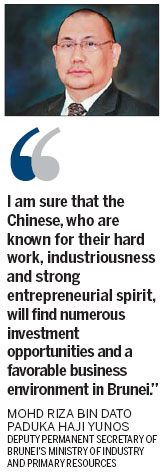
"I am sure that the Chinese, who are known for their hard work, industriousness and strong entrepreneurial spirit, will find numerous investment opportunities and a favorable business environment in Brunei," he added.
Since oil was found in commercial quantities in 1929, Brunei has had a small, well-to-do economy that is almost totally supported by exports of crude oil and natural gas. Revenue from the sectors account for more than 60 percent of its GDP.
But heavy reliance on energy has also forced Brunei's economy to be subject to the swings of the world oil market and to import a wide variety of items, including food. In the late 1990s and early 2000s, weak oil prices and the Asian financial crisis contributed to relatively low growth rates.
Because oil and gas reserves are dwindling, Brunei is taking steps to diversify its economy.
Brunei's non-petroleum industries include agriculture, forestry, fishing and banking. Agriculture and fisheries are being given the highest priority.
Mohd Riza cited the government-backed Brunei Halal Brand as an example of the country's commitment to diversification. The project, launched in 2009, was designed to make Brunei a global player in the growing sector of food products that are halal, or permitted under Islamic dietary guidelines.
"I am happy to say that several Chinese companies are participating in the contract manufacturing arrangement with Brunei's Ghanim International Food Corp Sdn Bhd to manufacture Brunei Halal Brand products, such as biscuits, cookies, snacks, chips, confectioneries and noodles," he said.
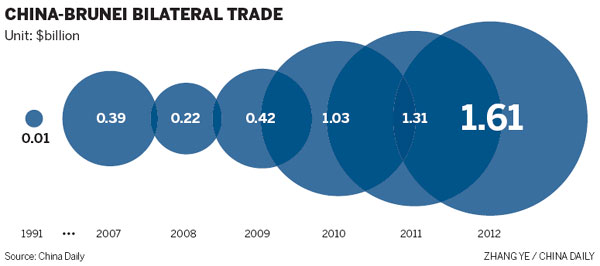
In addition to food processing, Chinese investment in Brunei also involves the construction of infrastructure, telecommunications, agriculture and fisheries. But the amount of Chinese investment in Brunei is much smaller than it is in other members of the Association of Southeast Asian Nations.
According to the China-ASEAN Council Chinese Secretariat, Chinese direct investment in Brunei ranked last among the 10 ASEAN members by the end of 2012. This made Brunei one of only two ASEAN countries that saw decreasing Chinese direct investment.
Mohd Riza said foreign investment had challenges, such as Brunei's "very small domestic market", but the government is expanding local industries' access to larger markets through active participation in regional and international forums, and is trying to provide a more favorable business environment for trade and investment.
Measures include providing integrated and comprehensive production and industrial sites to facilitate investment, as well as competitively priced utilities and excellent modern infrastructure, Mohd Riza said. He cited the example of Brunei Agro-Technology Park, a 500-hectare high-tech one-stop industrial community.
He also cited a number of advantages in investing in Brunei: its stable social and political system, the absence of a personal income tax and sales tax, and flexible regulations relating to foreign participation in equity.
zhaoshengnan@chinadaily.com.cn
(China Daily USA 12/18/2013 page6)