Astronomers say solar orbit likely melted comet
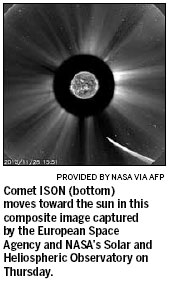
Comet ISON appeared to have flown too close to the sun on Thursday and vanished while circling the fiery surface, astronomers said.
The large block of ice and rock had been expected to skim just 1.17 million km above the sun's surface around 6:30 pm, London time.
It was estimated that ISON would withstand temperatures of 2,700 C and lose 3 million metric tons of its mass per second as it made its journey around the sun.
Most astronomers had predicted that ISON would not survive the trip.
Several solar observatories watched the comet during its closest approach to the sun, known as perihelion.
And the comet became faint while still within view of NASA's Solar Terrestrial Relations Observatory and the joint European Space Agency and NASA's Solar and Heliospheric Observatory.
NASA's Solar Dynamics Observatory, however, could not see the comet.
"It does seem that comet ISON probably has not survived its journey," Naval Research Laboratory comet scientist Karl Battams said after looking at space images.
"I am not seeing anything that emerges from behind the solar disk, and that, I think, could be the nail in the coffin," he told a roundtable organized by the US' National Aeronautics Space Administration.
Phil Plait of the Bad Astronomy blog agreed, saying he had a "strong suspicion that ISON may be an ex-comet".
Carey Lisse, a senior research scientist at Johns Hopkins Applied Physics Laboratory, compared the comet to a "loose snowball", rather weak and easily broken-up, with half to a third of its mass coming from water.
ISON is also about half the size of the average comet, with an estimated maximum diameter of 1.2 km.
ISON has galvanized astronomers since its discovery by a Russian team in September 2012 because it traces its origins to the start of the solar system some 4.5 billion years ago.
Several million years ago, ISON escaped from the Oort cloud, a grouping of debris halfway between the sun and the next closest star.
"This is a very dynamic situation. We have never seen a comet like this coming from the Oort cloud and going in the sun-grazing orbit," said Battams.
Lisse called it a "dinosaur bone" of the solar system's formation, stressing the key role of comets in building planets.
Agence France-Presse
(China Daily 11/30/2013 page7)