Increased cooperation brings mutual benefits
New joint investment between China and Eastern, Central Europe opens up markets
Stoyan Atsarov from Bulgaria was delighted after signing a cooperation agreement with a business partner in Yiwu, Zhejiang province, where his company plans to build its first factory in China. The Bulgarian company will produce rose-oil candy for Chinese costumers.
"The Chinese government is offering us favorable conditions for our operations in China," Atsarov, a representative of DEO Perfume Candy, told China Daily.
"I can't wait for the moment when our rose-oil candy is produced in China and launched on the Chinese market," he said. "Yiwu is just a pilot program, and we will build factories in other parts of China in the future."
Atsarov is not alone in his enthusiasm for working with China. With deepened mutual trust, China and Central and Eastern European countries are showing more interest in each other, creating a huge potential for future cooperation.
Enterprises and local governments from 16 Central and Eastern European countries signed 25 cooperation agreements with Chinese partners last week during a three-day meeting in Chongqing attended by local leaders from both sides.
Observers said China and countries in Central and Eastern Europe need each other for the development of both regions. They and partners beyond their borders benefit from such cooperation, they added.
To better boost their economic development, Central and Eastern European countries are expecting more Chinese enterprises to invest in their region.
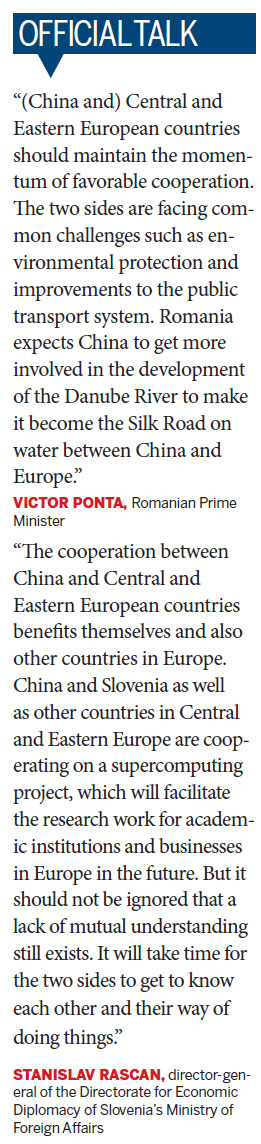
"Serbia highly welcomes Chinese investment in the country," said Milomir Premovic, a special advisor with Serbian Ministry of Internal Affairs, at the Chongqing meeting.
"Chinese investments in Serbia help promote the country's economic development and create job opportunities to ease the problem of unemployment. When Chinese enterprises manufacture products in Serbia, they can also boost exports for the country," he added.
Traditionally dependent for markets and funding on member countries of the European Union, Central and Eastern European countries are eager to find partners beyond the European continent to offset the negative influence the EU crisis on their economy, said Ding Chun, a professor at Shanghai's Fudan University.
Central and Eastern European countries are attempting to diversify their funding revenue, and China's investment can quicken their economic recovery and stabilize their markets, said Zhao Junjie, a researcher on European studies with the Chinese Academy of Social Sciences.
China's fast development offers a huge market for Central and Eastern European countries, which can help increase the countries' exports, Zhao said.
Meanwhile, more Chinese companies are interested in cooperating with partners in Central and Eastern European countries, which are a gateway to European and even North American markets for Chinese enterprises.
ZTE, China's second-largest telecom equipment vendor, is among those companies. In recent years, ZTE has strengthened its focus on markets in the region, and rapid expansion has been followed by increased investment in the region.
In 2012, ZTE and the Hungarian Ministry of Economics agreed to establish the company's new European regional network operation center in Hungary to improve its overall delivery capacity in Europe and provide management services for European telecom operators.
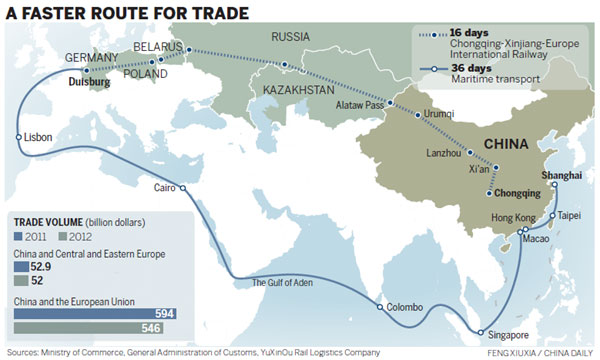
In 2011, the 11,179 km Chongqing-Xinjiang-Europe railway connecting Chongqing with Duisburg, Germany, via Kazakhstan, Russia, Belarus and Poland went into operation, delivering Chinese products directly to European customers at a lower cost.
The railway is an example of how cooperation between China and Central and Eastern European countries benefits third parties, as it can reduce costs and create more opportunities for the whole of Europe, Ding from Fudan University said.
Thanks to the railway, PC products producer Hewlett Packard, which has laptop plants in Chongqing, has significantly saved transport costs and time and thus benefiting its consumers worldwide, said Tony Prophet, HP's senior vice-president.
During a meeting with leaders of 16 Central and Eastern European countries in Poland in April 2012, former Chinese Premier Wen Jiabao introduced 12 measures for promoting friendly cooperation in comprehensive areas including politics, finance, trading and people-to-people cooperation.
In September 2012, China and 16 Central and Eastern European countries set up the China-Central and Eastern Europe Cooperation Secretariat, which is in charge of communication and coordination between the two sides.
Tan Yingzi contributed to this story.
(China Daily 07/12/2013 page10)