Saddam nostalgia lives on in hometown
|
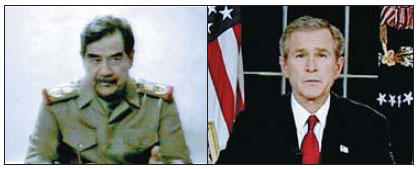
This combination of video images shows Saddam Hussein on Iraqi television on March 20, 2003, and then-US president George W. Bush addressing the nation from the Oval Office on March 19, 2003. Iraqi TV via FOX News via Associated Press |
A decade after the United States-led invasion of Iraq, years of violence and disdain for the country's current political class fuel nostalgia for Saddam Hussein - the man the foreign troops fought to oust.
Though accusations of ties to Saddam and his rule are used to tar politicians in Baghdad, residents of his hometown, Tikrit, express fondness for the man who, though responsible for ordering the deaths of countless Iraqis, is remembered for having imposed stability, which has long been missing.
"I will remain proud, and remember Saddam," said Khaled Jamal, a watch seller in Tikrit. "Our country has not changed or developed in the past 10 years."
Many Iraqis, not just in Tikrit, suffer from poor provision of basic services and high unemployment.
Along with his frustration over the slow pace of rebuilding, Jamal also voiced another commonly cited frustration: The apparent rise in sectarianism since Saddam's fall.
"There was no sectarianism, no Sunni and Shiite," Jamal said. "But now, that is the first question you hear when you meet someone," he added, referring to queries over a person's province of origin, often used to find out their religious background.
Rise to power
Saddam was born on April 28, 1937, in the village of Al-Oja, just south of Tikrit, which lies north of Baghdad.
An activist in the now-banned Arab socialist Baath Party, Saddam was sentenced to death in 1959 for plotting to kill Iraqi leader Abdul Karim Qassem, and was a senior figure in the party when it took control of Iraq in a 1968 military coup, though he only rose to power 11 years later.
Domestically, Saddam espoused a secular vision for the country and presented himself as an Arab leader who would stand up to neighboring Iran, but was brutal with his opponents.
He is thought to be responsible for the killings of tens of thousands of Kurds in the "Anfal" campaign, and of up to 100,000 people who took part in an uprising against his rule after the 1991 Gulf War, as well as other massacres.
Internationally, he fought a costly and deadly war with Iran from 1980 to 1988, and invaded Kuwait in 1990 before being evicted by a US-led international coalition, leading to crushing sanctions and a trade embargo against Iraq.
(China Daily 03/21/2013 page10)