US lawmakers fail to reach deal
|
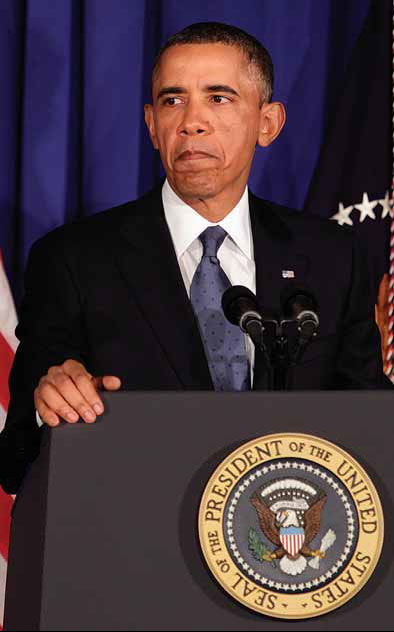
US President Barack Obama was scheduled to meet the leaders of the Democratic and Republican parties in the Senate and the House of Representatives on Friday after both parties failed to reach an agreement over the federal budget. Yuri Gripas / Reuters |
Mandatory spending cuts set to start on Friday after talks break down
With time running out, US lawmakers failed to reach an 11th-hour deal to avoid $85 billion in across-the-board spending cuts in the federal government, which were set to take effect in the country on Friday.
In the Senate, one bill each from Democrats and Republicans died without attracting enough support to be brought to a formal vote.
For now, it's unclear what effects the cuts, collectively known as the sequester, may have on the US public. President Barack Obama and others in his administration have warned that furloughs of federal workers could result in long lines and delays at US airports, the closing of national parks, and layoffs of teachers.
With the deadline for avoiding the sequester looming, exhausting the last chance for Congress to dodge the measure that Congress and Obama put in place in 2011, leaders of both parties in the Senate and the House of Representatives were to meet with the president on Friday. Obama summoned the four lawmakers to discuss next steps.
Without a deal, Obama must put sequestration into effect by midnight Friday, US Eastern Daylight Time (1 pm Saturday Beijing Time).
Debate over the sequester has been marked by partisan accusations of who's to blame and which party's agenda would reduce the federal budget deficit without stunting economic growth. The gridlock in Congress has continued since enactment of the Budget Control Act of 2011, which mandated cuts so deep and potentially unpopular that lawmakers claimed they would be pressured to find alternatives.
The cuts, divided between the defense budget and nearly all other forms of government spending, would total $1.2 trillion over nine years, in addition to the $85 billion affecting the remainder of Washington's fiscal year, which ends on Sept 30.
For Democrats, including Obama, negotiations on spending cuts must include tax increases on wealthy Americans, which Republican congressional leaders and many of the party's members oppose.
On Thursday, Obama criticized Republican senators for spurning the Democrats' proposal and accused them of siding with the rich on fiscal policy.
"Instead of closing a single tax loophole that benefits the well-off and well-connected, they chose to cut vital services for children, seniors, our men and women in uniform and their families," he said in a prepared statement. "They voted to let the entire burden of deficit reduction fall squarely on the middle class."
On Jan 2, Congress enacted an agreement with Obama to avoid most of the anticipated tax increases that would have come from another crisis, the so-called fiscal cliff. On top of sequestration, Washington faces a potential crisis from the expiration on March 27 of stopgap funding for government spending known as the "continuing resolution." To avoid a shutdown of many nonessential government functions, lawmakers will have to approve a new continuing resolution.
House Speaker John Boehner, an Ohio Republican, said on Thursday in a statement: "It's embarrassing that after 15 months, Senate Democrats still haven't passed a single sequester-replacement bill. Now that today's political stunt to raise taxes has failed, it's time for the president and Senate Democrats to do the hard work that is necessary to pass a bill in the Senate so we can begin to resolve this issue."
Eswar Prasad, a professor of international trade and economics at Cornell University, expressed concern about the potential effect of sequestration on the global economy. Both the worldwide and US economies are fragile, with uncertain growth prospects, he said.
"The fiscal drag and economic uncertainty spawned by this sign of policy gridlock in Washington is going to hold back the US economic recovery both directly and through its negative effects on business and consumer confidence," said Prasad, a former China division chief for the International Monetary Fund.
"If the sequester does damage the US economic recovery, the world will once again have to turn to China as the main contributor to world growth in 2013," he said. "China's export growth will take another hit if the US and Europeans economies continue to perform poorly this year."
Prasad said a return of the US economy to recession, particularly if accompanied by a significant increase in unemployment, could heighten US-China economic tensions.
"At the moment, the attention of US policymakers is entirely focused on domestic issues, so this may not be a pressing concern. But there is a risk that a weak labor market and a rising bilateral trade deficit with China could lead to rising trade tensions later this year," he said.
Contact the writers at josephboris@chinadaiyusa.com and chenweihua@chinadailyusa.com
(China Daily 03/02/2013 page8)