NASA to boost meteor defense
|
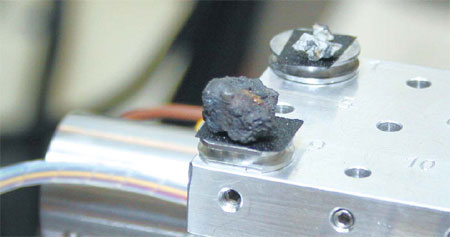
A handout photo taken on Monday shows pieces of porous black rock, reportedly fragments of the meteor that spectacularly plunged over Russia's Ural Mountains, as scientists work on them in a university lab in Yekaterinburg. Urals Federal University via Agenec France-Presse |
|
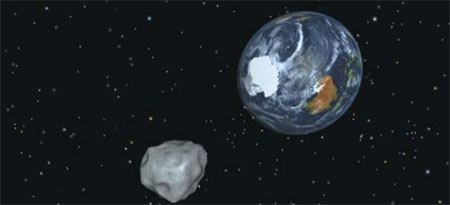
This graphic depicts the Earth flyby of asteroid 2012 DA14. NASA is now working on asteroid warning systems that can detect objects from space like the one that struck Russia last week. NASA via Agenec France-Presse |
Agency says some asteroids are hard to detect because of their size
NASA, universities and private groups in the US are working on asteroid warning systems that can detect objects from space like the one that struck Russia last week with a blinding flash and mighty boom.
But the US space agency reiterated that events like the one in the Urals, which shattered windows and injured nearly 1,200 people, are rare.
"We would expect an event of this magnitude to occur once every 100 years on average," said Paul Chodas of NASA's Near-Earth Object Program Office at the Jet Propulsion Laboratory in Pasadena, California.
NASA estimates that before entering Earth's atmosphere above Russia, the asteroid measured 17 meters in diameter and weighed 10,000 tons.Fragments of the asteroid caused an explosion equivalent to 500,000 tons of TNT when they hit.
The same day, an asteroid 45 meters in diameter, known as 2012 DA14, whizzed harmlessly past the Earth, its passage overshadowed by the bright arc drawn across the Russian sky the same day. But had it hit the ground, it could have obliterated a large city.
Ten years ago, NASA would not have been able to detect 2012 DA14, Lindsey Johnson, near-earth object project manager at NASA, said recently. But he said the agency has made progress on learning how to detect small asteroids.
Johnson said there are many of these objects flying around near Earth - say, half a million - and they are hard to track because of their size.
In line with a goal set by the US Congress in 1998, NASA has already discovered and catalogued around 95 percent of the asteroids of a kilometer or more in diameter that are in Earth's orbit around the sun and capable of causing mega-destruction.
The NEO program at NASA detects and tracks Earth-approaching asteroids and comets with land-based and orbiting telescopes. Scientists estimate their mass and orbit to gauge whether they pose a danger.
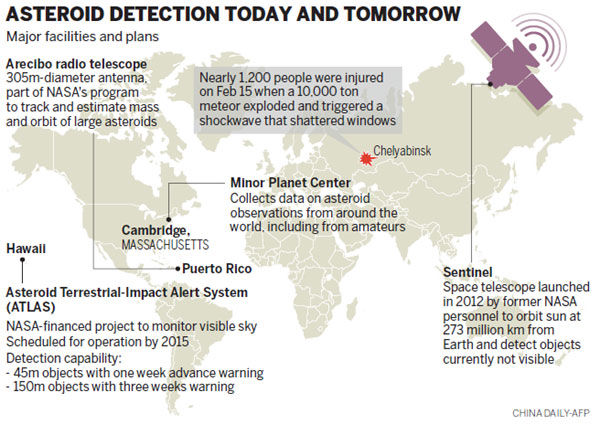
With this system, the Arecibo radio telescope in Puerto Rico, which has an antenna 305 meters in diameter, can observe with great sensitivity a third of the night sky, and detect asteroids that are on the large side.
All asteroid observations made anywhere in the world by telescopes, even by amateur star gazers, must be passed on to the Minor Planet Center, which is financed by NASA and run by the Smithsonian Astrophysical Observatory for the Paris-based International Astronomical Union.
But in times of tight budgets like these, NASA is trying to develop other systems specifically capable of tracking small objects in space.
It is financing to the tune of $5 million a project at the University of Hawaii called Atlas, or Asteroid Terrestrial-Impact Alert System.
Researchers say ATLAS, which will monitor the entire visible sky every night, will be able to detect objects 45 meters in diameter a week before they hit the planet.
For those measuring 150 meters in diameter, the system - which could be operational in late 2015 - will give a three-week warning.
The goal is to find the objects and give enough advance warning for measures to be taken to protect people, said John Tonry, the principal investigator at ATLAS.
The system has sufficient sensitivity to detect a match flame in New York City when viewed from San Francisco, for instance.
"That's enough time to evacuate the area of people, take measures to protect buildings and other infrastructures and be alert to a tsunami danger generated by ocean impacts," according to the ATLAS website.
But NASA's efforts are deemed insufficient by former agency astronauts and scientists who last year launched a project designed to finance, build and launch the first private space telescope to track asteroids and protect humanity.
The foundation, called B612, is trying to raise $450 million to build and deploy a space telescope, named Sentinel, in orbit around the sun, at a distance of 273 million km from Earth to detect most objects that are otherwise not visible.
Agence France-Presse
(China Daily 02/20/2013 page10)