Most regions expect double-digit growth
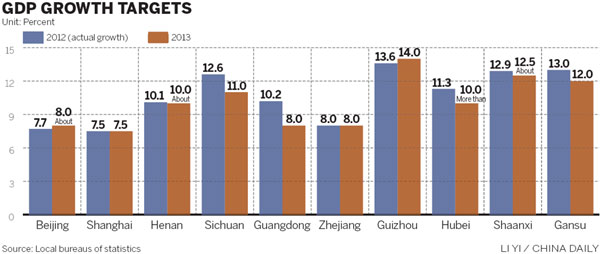
Guizhou sets highest target of 14% for 2013; Shaanxi is next at 12.5%
Local economic targets for 2013 - just released by 31 provincial-level governments on the Chinese mainland - show that officials across the country expect similar rates of growth as last year, with coastal regions again accelerating slower than western areas.
Despite a year in which China's overall economic growth eased to its slowest rate in 13 years at 7.8 percent, 24 regions have set their growth target for 2013 around or higher than 10 percent, and seven have targeted growth below 10%, one more than in 2012.
In figures submitted within the latest annual government work reports, officials in Beijing, for instance, are aiming to grow the city's economy by 8 percent in 2013, slightly higher than its 7.7 percent growth in 2012 while Shanghai has set a 7.5 percent target, the same as for 2012.
But this year's target list is headed by Southwest China's Guizhou province, with an expected growth of 14 percent, followed by northwestern Shaanxi province at 12.5 percent, then 10 others with a target of 12 percent.
At the beginning of 2012, six regions set a single-digit GDP growth target, and 25 set one in double-digits.
Zhang Liqun, a researcher with the Development Research Center of the State Council, said historically growth figures tend to turn out higher than pre-set targets, as some local governments initially err on the cautious side - but he added this year's targets, which largely mirror last year's list, do reflect a realism among provincial-level government economic departments that overall national growth will remain slower than the years up to 2012.
For example, both Guangdong and Zhejiang have set 8 percent growth targets for 2013, against their 2012 goal of 8.5 percent.
Strikingly, said experts, the country's vast central and western regions are setting the pace, with most still aiming for double-digit acceleration this year, as they aspire to continue the "leapfrogging" development seen in recent years, and as they grow faster than some of China's traditional economic hotspots.
Part of that optimism lies in last year's good performance.
Of the 31 provinces, municipalities and autonomous regions, 29 beat national economic growth of 7.8 percent last year.
The only exceptions were Beijing and Shanghai, which grew 7.7 percent and 7.5 percent, respectively.
A compilation of the local figures shows that China's GDP is expected to hit 57.69 trillion yuan ($9.15 trillion) in 2012, some 5.76 trillion yuan more than the national GDP figure released by the central government.
That's a gap the equivalent to Guangdong's GDP, which will only add to skepticism by some media of the authenticity of local government data.
However, some experts on how local GDP figures are compiled, told China Daily that gaps do occur and that national accounting often eliminates repeated calculations made by local governments.
Zhu Baoliang, an economist at the State Information Center, a think tank under the National Development and Reform Commission, said the central government is aware that local governments can tend to inflate their data.
But he added that as larger gaps appear, significantly larger than in recent years, the central government will be determined to make sure all future data are correct.
Last year, Tianjin led the nation's growth table with 13.8 percent year-on-year GDP growth, followed by Guizhou and Chongqing, both with 13.6 percent growth.
The Inner Mongolia autonomous region grew 11.5 percent in 2012, giving its economy a GDP value of 1.59 trillion yuan.
Given its relatively small population (25.7 million), its GDP per capita surpassed $10,000 for the first time, along with Beijing, Shanghai, Tianjin, Jiangsu and Zhejiang.
Lu Ming, an economics professor with Shanghai Jiao Tong University, said the fast growth being experienced in regions such as Tianjin, Chongqing and Inner Mongolia, was understandable, given their strategic locations and rich natural resources.
But the fast acceleration of many other regions also worried him.
"In pursuit of GDP growth, local governments rely too heavily on fixed-asset investment. The result is homogeneous industrial structures," said Lu.
For example, in central areas of the country, four provinces - Henan, Hubei, Anhui and Jiangxi, all adjacent to one other - have listed often-unpredictable automaking industry as their regional pillar industry.
Low interest rates have also emboldened local governments to expand their credit lines beyond historic levels, which could present a potential threat to China's economy, Lu added.
According to figures provided by Haitong Securities Co Ltd, quoted in a report in Economic Information, a newspaper affiliated with Xinhua News Agency, local government debt is estimated to have grown to 13 trillion yuan by the end of 2012, representing 25 percent of GDP.
Analysts have called for quality to be given priority over growth rates.
zhengyangpeng@chinadaily.com.cn
(China Daily 02/05/2013 page13)