Reforms to give more weight to capital exports
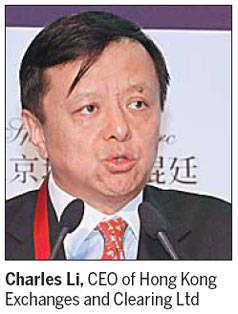
The next significant opportunity in China's financial reform is promoting capital exports instead of imports, and raising the value of financial and monetary assets, said Charles Li, CEO of Hong Kong Exchanges and Clearing Ltd.
The target of this "capital going-out" process is strengthening the global influence of the yuan, rather than simply seeking capital returns, Li said on Thursday at an economic forum hosted by Caijing magazine.
"It will be the third wave of China's opening-up after the surge of foreign trade and overseas mergers and acquisitions," Li said.
Large capital relief is expected on the premise of the capital market's opening as well as exchange rate reform, he said. Capital relief can also enhance yuan-settled cross-border trade and facilitate overseas M&A biddings.
"The first stage of renminbi internationalization has started, but it seems the impetus is not strong enough now to push it to the next level," Li said.
One of the 12 most expected reform areas voted in a survey is achieving yuan-free convertibility in capital items, according to Qin Xiao, the former chairman of China Merchants Group and now the chairman of the board of Boyuan Foundation, an organization focusing on economic and social research.
"An increasing number of people now have confidence about the capital opening, and they though it won't take too much time," Qin said.
Ma Jun, the managing director and chief economist for China of Deutsche Bank, also was optimistic. "We have made a quantitative analysis, and the result showed that opening the capital system will have less effect on the net capital flow and renminbi exchange rate than they worried about," Ma said.
An excess of worry among policy makers has obstructed the free flow of capital, Ma said. "It needs to do research to gauge the potential risks and remove unnecessary fears of the reform."
Ma suggested hastening the development of the market for the renminbi-denominated bond, which is also known as the "dim sum bond." "It is a way to transfer the country's overseas assets into renminbi denominated and reduces the exchange rate risk," Ma said.
It is also expected to open the bond system to foreign interbank debt markets, which means allowing more foreign financial institutions to issue bonds in China, and they can also hold more RMB bonds issued by Chinese government and companies, he added.
Investors overseas have shown their revived appetite for financial product after the yuan recently climbed to a 19-year high and China's new leadership pledged to further carry out reform and open up the economy.
Only banks in the Chinese mainland and Hong Kong could issue the dim sum bonds until July 2010.
chenjia1@chinadaily.com.cn
(China Daily 11/30/2012 page15)