Consumption 'set for driving role' in growth
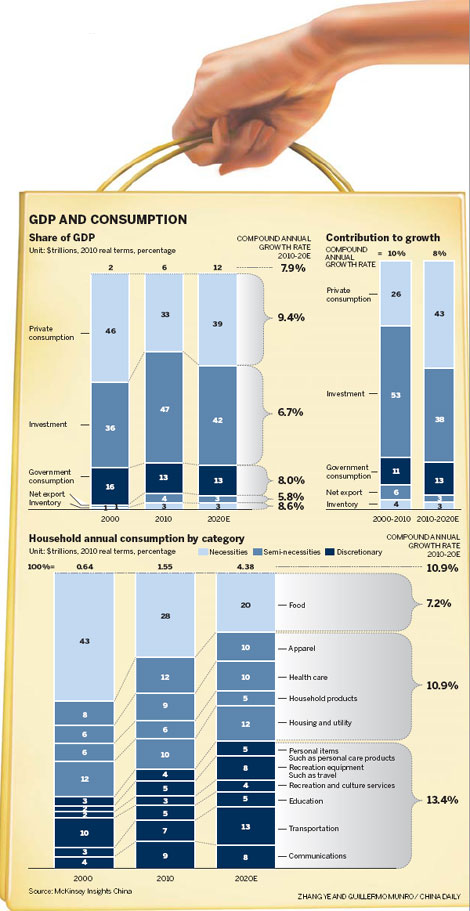
A consultants' report has identified private consumption as the primary driver of economic growth in China through 2020, as it will account for 43 percent of GDP growth by that year compared with 26 percent at present.
McKinsey & Co conducted the survey by interviewing 15,000 respondents in 49 Chinese cities, including a large sample of middle-class people. The firm said the survey covered consumption patterns for 60 products involving 300 brands.
The report, released on Wednesday, said consumption-led economic growth reflected several factors: surging disposable incomes, rapid urbanization, government efforts to boost consumption by improving social security and technological transformation.
McKinsey said the investment component's contribution to GDP growth will drop to 38 percent by 2020 from 53 percent now.
Private consumption will account for 39 percent of GDP by 2020, while the share of investment will be 42 percent and that of government consumption will be 13 percent, the report added.
"The Chinese government is smart to deal with the issue by taking measures seriously to bolster domestic consumption," said Max Magni, a principal at McKinsey based in Hong Kong.
"Chinese economic growth will rely more on its domestic market rather than on other countries."
According to the report, the longstanding shortfall in the contribution of consumption to economic growth in China, as illustrated by a high savings rate, reflects public concerns about the social security net.
The report said the government's policy of increasing pension coverage in urban areas from 250 million people now to 350 million by 2015 will help boost domestic consumption.
Regarding disposable incomes, the report found that middle-class households (defined as those with annual incomes of 106,000 yuan to 229,000 yuan, or $16,000 to $34,000) as a proportion of the urban population will rise from 6 percent now to 51 percent by 2020.
"The disposable income growth of Chinese consumers will fuel more discretionary and aspiration-driven spending, which includes the purchase of better-quality items such as family cars and small luxury items, which translates into higher profits for retailers," said Yuval Atsmon, another principal at McKinsey.
Rapid urbanization and technological transformation are the other backdrops to the rise of consumerism in the mainland. According to the McKinsey report, the urban population will jump to 846 million by 2020 from the current 665 million.
The number of Internet users will skyrocket from the current 420 million to more than 1 billion by 2020.
oswald@chinadailyhk.com
(China Daily 03/08/2012 page13)