Avoid armadillos and leprosy
|
New fi ndings discourage the eating of armadillo meat. Provided to China Daily |
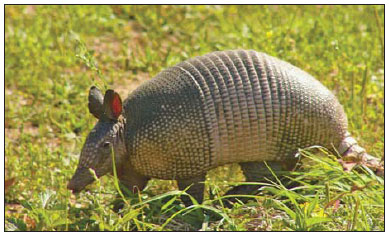
Armadillos, with their sharp claws and body armor, don't have a reputation for being cuddly.
New research findings may make them even less appealing - they turn out to be a potential source of leprosy in genetically susceptible humans, with a strain of leprosy found in humans in the United States' south identical to one common in nine-banded armadillos in the region.
The results, in the New England Journal of Medicine, suggest that species in other parts of the world might be an unrecognized reservoir of leprosy - also known as Hansen's disease and caused by the bacterium Mycobacterium leprae.
"Around the world, we think of human beings as the only reservoir of Mycobacterium leprae and that leprosy is a human disease," says Richard Truman of the National Hansen's Disease Program in Baton Rouge, Louisiana, who led the study.
"While some people have suspected this link for a long time, no other kinds of environmental reservoirs are found elsewhere in the world, so it was easy for individuals to discount the idea," he says.
Leprosy is a largely misunderstood condition. It is very hard to catch, requiring repeated exposure, and 90 to 95 percent of the population is immune to it.
Slow-growing skin lesions are the best-known sign of an infection but the bacterium also affects peripheral nerves, the eyes and the upper respiratory tract.
When doctors recognize it, which they may not do because it is so rare, it can be cured by antibiotics.
Leprosy experts have known for years that armadillos carry the leprosy bacteria, while studies have shown that people with unexplained cases of the disease - those who have never had any contact with sufferers - often live in areas where armadillos are common, such as the states of Texas and Louisiana in the US south.
Truman's study used DNA testing to show that a strain of the bacterium not found anywhere else in the world was present in 28 out of 33 wild armadillos and 25 out of 39 leprosy patients who lived in areas where the animals also lived.
"We have confirmed that environment reservoirs can be important in the transmission of leprosy. Whether or not they exist elsewhere in the world merits additional investigation," Truman says.
Researchers think the reason the leprosy bacteria grow in armadillos, but not in most other animals, is due to the armadillos' lower body temperature of 32 C.
The findings mean people should be discouraged from frequent contact with armadillos, or cooking and eating their meat, the researchers say.
Reuters
(China Daily 05/04/2011 page19)