Water Inside, Water Out
|
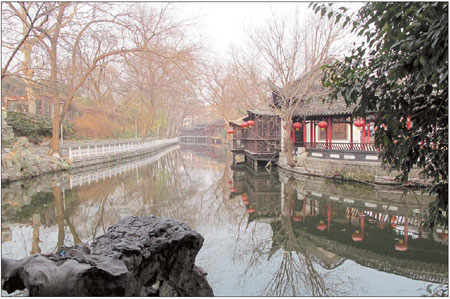
Yechun Teahouse, Yangzhou's most renowned, is set amidst an elegant and ancient garden of the traditional style so loved by salt traders of the past. Photos by Han Bingbin / China Daily |
|
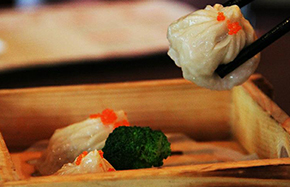
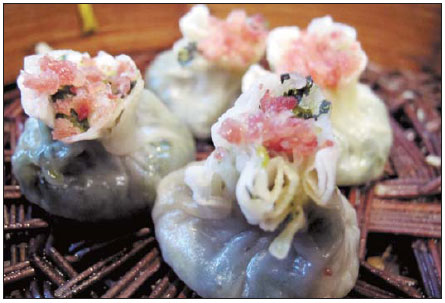
Steamed meat dumplings, or shaomai, look like delicate jewels of agate and jade. |
Yangzhou natives are immensely proud of the city's attractions, and are not above teasing first-time visitors a little. Han Bingbin shows off his home town which, he says, is eponymous with the good life.
Almost every traveler to Yangzhou starts with puzzling out a conundrum that local people repeatedly use to tease outsiders with: In the morning, skin wraps water, in the evening, water wraps skin. The answer, of course, sums up the two most famous attractions of the city, and the activities all locals devote much time to ?soup dumplings at Yangzhou's famous breakfast houses, and soaking up the ambience of its equally famous bathhouses.
Bathhouses are still a throwback to tradition, and they remain the domain of men, but the experience of breakfast at a Yangzhou teahouse, or more accurately "tea society", with all its social connotations can be and is enjoyed by all.
Tea drinking, however, is far from being the main activity at the breakfast clubs. It is usually the array of delicacies with an admirably long history and good reputation that attracts the crowds, although the names of these establishments are also acknowledgements of the city's poetic legacy.
Here, breakfast is not about satiating the appetite. It is about the holistic process of refreshing the mind with cunningly named snacks with literary allusions, enlightening exchange among scholars and perhaps, a moment of solitary meditation.
It may be hard to even imagine the scenario anywhere else in China, where normal teahouses are usually noisy, shabby and greasy. To truly understand the experience, you need to place yourself at breakfast on an old-fashioned terrace lined with windows of carved flower frames, through which you look out at a meandering creek with willow trees fringing the banks, dipping slender branches into the water.
This perfectly describes Yangzhou's most renowned teahouse set amidst an elegant and ancient garden of the traditional style.
Yechun Teahouse is named after the private garden of Qing Dynasty poet Wang Yuyang, and with its history of more than 200 years, it can be said to be a living relic of a once-flourishing era.
It started life as "Yechun flower house" where renowned Chinese gardener Yu Jizhi planted his flowers and bonsai and also ran a teahouse selling desserts early in the last century. It later evolved into a meeting place for the literati, and became known as a poet's society where scholars congregated. Yechun later merged with another famous teahouse, Qingsheng, and became what it is today.
In 1994, an extra 2,300 square meters was added to expand the business and now the teahouse combines both pleasures - eating and bathing.
But what sets it apart from its competitors is a menu of more than 40 types of local delicacies; crabmeat dumpling, sanding baozi (steamed bun stuffed with a trio of diced pork, chicken and bamboo shoot) and jade-colored shaomai or steamed meat dumplings.
Located near Yu Matou (the old Imperial pier), which marked the start of the so-called Qianlong water route, Yechun teahouse is a microcosm of the city's elegant attractions. Taking a boat from the teahouse, visitors can follow the emperor's river voyage all the way to the city's most famous Slender West Lake and still further to the Daming Temple.
But what draws me back repeatedly is the unforgettable narration by the novelist Zhu Ziqing, who described an obsolete tradition from a more gracious past so vividly.
Travelers on the boats would pass Yechun and chat with tea drinkers on the banks, collecting a pot of tea and snacks on credit. They would then continue their journey upriver - singing, eating and drinking.
As they cruised back down, they would stop by again, and pay for what they took.
(China Daily 01/30/2011 page16)