BASF: 80% drop in home energy use
An old building that uses 80 percent less heating fuel than a modern structure?
It sounds like a fairytale, but German chemical company BASF has made it a reality.
Using insulation materials produced by the company together with other energy efficient strategies, BASF has retrofitted many old buildings in Europe to become "three-liter houses" - the amount of heating oil they use per sq m per year.
According to company statistics, energy consumption in the renovated buildings can be reduced by 80 to 90 percent and CO2 emissions cut by 80 percent compared to conventional buildings.
BASF also started similar projects in China. The company has finished a project with the Ministry of Housing and Urban-Rural Development and the Shanghai municipal government on a three-liter housing project in the city's Hongkou district. Projects in other cities in the country are also in the pipeline.
The German company is paying increasing attention to energy efficiency in buildings in China, said Johnny Kwan, board chairman of BASF Greater China.
"We provide not only products but also full solutions to help our customers achieve their goals in energy consumption and pollution control," Kwan said.
This year BASF signed an agreement with the Hamburg House pavilion at Shanghai Expo 2010 to make it so ecological that it used no active heating or cooling systems.
Part of the German complex for the expo, Hamburg House maintains a constant indoor temperature of 25 C without consuming any electricity from the grid and without the use of air conditioners or heaters.
The achievement came through advanced architectural design and energy technologies that BASF hopes can be applied in China to improve the quality of life and promote a culture of sustainable building, said Kwan.
Green portfolio
The chemical industry, which provides raw materials to many downstream sectors, will play an important role in China's efforts in building an environmentally friendly economy, said Kwan, adding that BASF is boosting its green portfolio in China.
In April BASF announced that it will build a polyurethane plant in Chongqing to produce plastics products. The company also plans a world-scale facility to make 400,000 tons of the polyurethane-related chemical MDI annually in the city.
"The market for polyurethane systems in western China will continue to grow significantly," said Melanie Maas-Brunner, head for polyurethanes in Asia Pacific of BASF.
"The growth is to a large extent driven by insulating materials for the construction industry, which will play an important role in saving valuable energy."
In addition, BASF expects the region to continue its strong demand for other polyurethane products used in transportation, appliances and footwear.
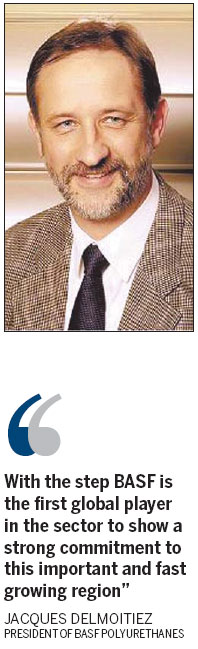
"With this step BASF is the first global player in the sector to show a strong commitment to this important and fast growing region," said Jacques Delmoitiez, president of BASF Polyurethanes.
"The new plant will be fully backward integrated into the planned MDI plant - a significant advantage our customers can benefit from. And they will also benefit from the know-how and experience of BASF employees worldwide."
Last year BASF and China's largest refiner Sinopec announced that they would together invest $1.4 billion to expand their joint venture in Nanjing in Jiangsu province.
The expanded project will produce downstream specialty chemicals for the Chinese market, serving multiple industries including construction, electronics, pharmaceuticals, automotive and chemical manufacturing.
Part of the investment by joint venture BASF-YPC Co Ltd (BYC) will fund expansion of its existing steam cracker facility - which produces ethylene, the raw material for plastics and synthetic fibers - to an annual capacity of 740,000 tons.
The investment also includes construction of 10 new chemical plants and the expansion of three existing facilities. BYC, the 50-50 joint venture between BASF and Sinopec, was founded in 2000 with a total joint first phase investment of $2.9 billion.
(China Daily 05/07/2010 page15)