Afghanistan rescue puts media in dock
WASHINGTON: The bloody rescue of a New York Times reporter in Afghanistan has spurred accusations of media recklessness, a charge the paper's editor denies but one that has prompted some soul searching.
Early on September 9, the buzz of military aircraft over northern Afghanistan gave British-Irish journalist Stephen Farrell the first inclination he was about to be rescued.
Within moments, the veteran New York Times reporter was free - wrenched by British special forces beyond the grasp of his Taliban captors, ending four terrifying days of detention.
But Farrell's liberation cost the lives of his Afghan colleague, Sultan Munadi - a father of two, 29-year-old British paratrooper John Harrison, an Afghan woman and child, and scores of Taliban fighters.
As details of the rescue emerged they were quickly followed by recriminations.
Four days earlier Farrell and Munadi, both dressed in local clothes, had set off to investigate a NATO air strike near Kunduz, where there were reports of numerous civilian casualties.
It was just the latest in a series of deadly coalition air strikes that killed civilians, deepening Afghan opposition to NATO's eight-year-long mission and making a mockery of a US drive to limit civilian casualties.
Munadi's brother accused the British government of being too quick to launch the raid, claiming that negotiations to free the pair may have worked. He also lashed out at the Afghan governments, the Taliban and the New York Times.
British Foreign Secretary David Miliband, under heavy criticism for ordering the raid, lambasted Farrell for ignoring what he said was "very strong" advice not to travel to the area.
Richard Kemp, a former member of COBRA, the British government's top-level crisis group often called to respond to kidnappings, acknowledged the story was an important one, but said Farrell had more than his own life to consider.
"He unnecessarily risked the lives of his Afghan fellow journalist Sultan Munadi - and those who might have to rescue him," Kemp wrote in the Daily Mail.
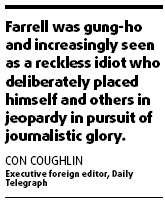
Con Coughlin, executive foreign editor of London's Daily Telegraph was more scathing, writing that Farrell was "gung-ho" and "increasingly seen as a reckless idiot who deliberately placed himself and others in jeopardy in pursuit of journalistic glory".
In an email to AFP, Times executive editor Bill Keller defended the paper's role in the "heartbreaking" episode and described the formidable calculus of deciding whether to embark on an important, but potentially dangerous assignment.
"It was an important story - a report of scores of dead innocents at a very sensitive period in the politics of Afghanistan - that could not be verified by phone calls or the Afghan rumor mill," Keller wrote.
"It called out for on-the-scene reporting if possible."
"I have seen no evidence that his reporting mission was reckless or irresponsible," he said.
On the Times website, Farrell said he was comfortable with his decision to go to the area, but admitted he and Munadi may have lingered there too long.
Western governments have steered the media toward "embeds" - having journalists travel with coalition forces to the front lines.
Christopher Paul, a Rand Corporation expert on military-media relations, said this option offers the military an opportunity to show its side of the story and limit the risk of causalities that could bolster opposition to the military mission at home.
But according to Paul, the fact that many journalists working in Afghanistan and Iraq, like Farrell, are from countries prosecuting the war poses additional questions of control.
"There are government advisories not to travel to certain places so it is implicit you do so at your own risk," said Paul. "Does a journalist have any more claim to protection... than a civilian from the same country?"
The debate, he said, "is about who makes the call."
For Farrell's supporters journalists must always be able to make the call, because there are always places and events that governments would rather reporters don't cover, for reasons that are far from altruistic.
They also point to the role that independent journalism has played in exposing the realities of the Vietnam War, Cambodia's killing fields, or the Cold War conflicts in Central and South America.
Marvin Kalb, a doyen of American journalism and Harvard professor emeritus, said the basic dilemma is long-standing: "It comes down to a question of what a reporter is prepared to do to get a story.
"I don't know whether Farrell should have dug so deeply on that story," Kalb told AFP, "but how are you going to say that to a journalist? There can't be any rules."
AFP
(China Daily 09/21/2009 page14)