No let-up in foreign money in real estate
Over a year has passed since six ministers jointly released Circular 171 last July to rein in foreign investment in China's sizzling property sector.
The circular, to some extent, has slowed the entry of speculative foreign capital, but has had almost no impact on long-term investors.
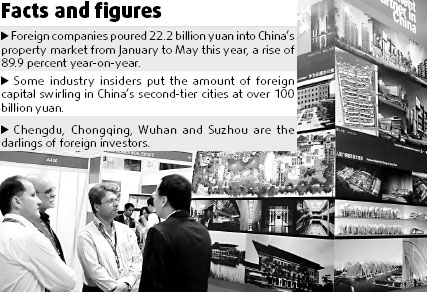
The National Bureau of Statistics said on June 19 that foreign companies poured 22.2 billion yuan into China's property market from January to May this year, a rise of 89.9 percent year-on-year.
On the same day, Aetos Capital, a US hedge fund, inked a deal with the country's largest insurer, China Life, on a $1 billion investment in China's property sector.
Also on June 19, Glitnir Bankhf, a financial institution from Iceland, announced cooperation with CGC Overseas Construction Co to co-develop a residential block in Shenyang, the capital of Northeast China's Liaoning Province.
"In the short run, macro policies increase business uncertainties. But in the long run, China's property market will be more attractive for foreign investors after the bubble is burst, especially with the renminbi continuing to appreciate," said Eric Chan, deputy managing director of Savills Property Services (Beijing) Company.
The high return, experts say, is the driving force behind foreign funds' strong interest in China's real estate sector.
According to a report by CB Richard Ellis, an international real estate services firm, the investment returns on office buildings in Beijing and Shanghai hit 8 percent in 2006, the highest in the world.
RREEF, a real estate arm of Deutsche Bank, said in a recent report that the gross profit margin of China's residential buildings could be as high as 20 to 30 percent, which could beat that of the US in the future.
"Expecting continued appreciation of the renminbi, foreign capital is flowing into second-tier cities such as Tianjin, Hangzhou, Chengdu, Shenyang and Chongqing," the central bank said in a report on July 31.
Some industry insiders put the amount of foreign capital swirling in China's second-tier cities at over 100 billion yuan.
Chengdu, Chongqing, Wuhan and Suzhou are the darlings of foreign investors. In Chengdu, foreign investors occupy almost half of the market. Other cities, such as Nanjing, Hangzhou and Ningbo, have also attracted foreign investors in droves.
"Our focus this year is on the residential sector in China's second-tier cities," Robert Lie, CEO of ING Real Estate Investment Management Asia, had once told China Daily. "Among our eight projects in the country, six are in second-tier cities."
He said his company is optimistic about the economic prospects of second-tier cities, especially Chongqing, Chengdu and Wuhan in the western and central regions. Dalian, Qingdao and Hangzhou are as attractive.
Ronnie Chan, chairman of Hong Kong-based Hang Lung Properties, said the company will not increase its investments in Shanghai. Instead, it will pour around HK$20-25 billion into 10 second-tier cities.
"Because of less competition and the more welcoming attitude of local governments, foreign investors have sped up their entry into second-tier cities," said Anna M. Kalifa, head of the Research Department of Jones Lang LaSalle (Beijing Branch). "And the returns in second-tier cities are usually higher."
Property prices in second-tier cities are soaring. Beihai, a small city at the southern end of South China's Guangxi Zhuang Autonomous Region, has been on the top of a list by the National Development and Reform Commission (NDRC) for four months in a row for its skyrocketing property prices.
Bengbu, a city in East China's Anhui Province, also found itself on the list. The city, ranked 182nd in overall economic strength in the country last year, appears as No 2 on the chart with a June growth rate of 9.9 percent.
However, Kalifa doesn't think the property price hike in second-tier cities is driven by foreign investors. "It is mainly due to excess liquidity and strong demand in the market."
The local developers, she said, are often more speculative than foreign investors.
(China Daily 08/17/2007 page15)