|
Policy changes in the pipeline
2008-07-15
China Daily
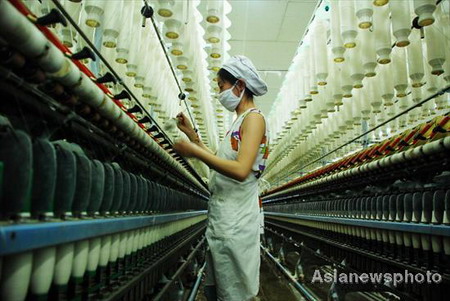 A woman works at a textile plant in Huaibei, Anhui province on July 9, 2008. Exports of the most seriously influenced textile and garment sectors declined by 4.2 percent year-on-year to $15.5 billion in June, representing the slowest increase in five years. [Asianewsphoto]
 |
A slowdown in exports as indicated by the first-half Customs data has drawn concerns from both companies and policymakers alike to make policy changes in sectors which have been badly hit.
Trade surplus for the first six months shrank to $99 billion, down by 11.8 percent year-on-year. Trade surplus in June alone declined by more than 20.6 percent, making it $5.5 billion less than the previous month.
Exports of the most seriously influenced textile and garment sectors declined by 4.2 percent year-on-year to $15.5 billion in June, representing the slowest increase in five years.
Though the high trade surplus has been the top concern for economic policy for a long time, exports contribute a large part to the overall economic growth. Drawn by the slowdown in exports, the economic growth for the first quarter reached 10.6 percent, compared with 11.9 percent the same period of last year.
Therefore, the latest figures have led industries to suggest that policies may shift to support the export businesses.
According to a report by China Jianyin Investment Securities, a proposal made by China National Textile & Apparel Council had been turned to the State Council. The report said that the tax rebate for textile materials will increase from 11 to 13 percent, and that of the garment sector will raise to 15 from the current 11 percent.
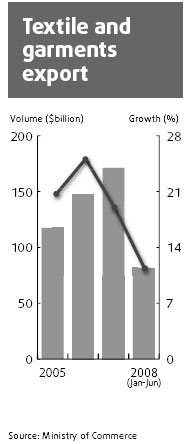
The pain of export-oriented industries has also drawn attention of policymakers. Premier Wen Jiabao visited Shanghai and Jiangsu at the beginning of the month. According to media reports, he asked about the influence of the removal of exports tax rebate.
Last week, other top leaders including Vice-Premier Li Keqiang and Commerce Minister Chen Deming both went to export-oriented provinces and visited enterprises, many of which were in the textile sector.
These visits were seen as a sign for policy changes, and the most widely discussed was the export tax rebate policy.
Export tax rebate of many textile materials and garments were removed or cut down last year when the high trade surplus was the major policy concern. The government also removed the favorable polices because most textile manufacturing enterprises are energy consuming and may lead to environment pollution.
But several months after the policy was put into effect, China's textile companies are also facing unexpected challenges, including rising raw material prices, labor cost, the appreciation of the yuan and the slowdown of US economy.
The export has slowed down since the beginning of the year. Companies and industry associations have started to urge for a policy change ever since April.
Zhang Yansheng, an expert with a research institute under the National Development and Reform Commission, was quoted by China Security Journal as saying "if the adjustment measures go too far, there will be a big influence on export-oriented enterprises, especially the small and medium-sized enterprises".
|


.gif)



.gif)

