

 Comments
  Print
Print  Mail
Mail  Large Medium Small
|
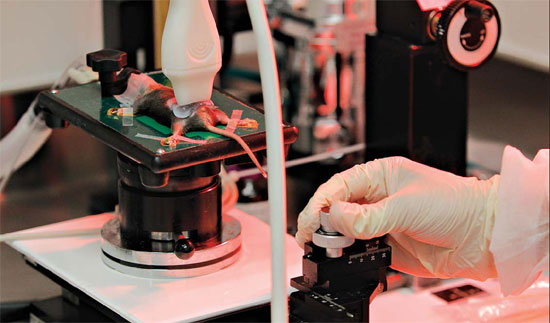
Scientists use miniature equipment to study cancer in mice, which have specific genetic mutations, to see if they can develop treatments for humans. Above, a mouse gets an ultrasound. Photographs By Jessica Rinaldi for The New York Times |
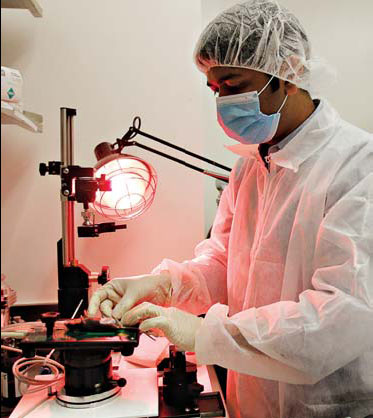
BOSTON - Here at Beth Israel Deaconess Medical Center, a mouse lies on a miniature examination table, his tail dangling off the end. A plastic tube carries anesthetic to his nose and mouth.
Before he was born, the mouse was injected with two mutated genes often found in human prostate cancer. Now a technician is measuring the mouse's two-millimeter prostate tumor with a petite ultrasound machine - the very exam a man would undergo, only on a dollhouse scale.
"There's the tumor," says the technician, Bhavik Padmani, sliding a probe over the mouse as a bright white amoebalike shape comes into view.
The animal is in what is called a "mouse hospital," a new approach to using mice to study cancer. Although mice have been studied in regular labs for years, the results often have disappointed. Drugs that seemed to work in mice often proved useless in humans.
The mouse hospital at Beth Israel Deaconess and a few similar ones elsewhere are at the forefront of a way of studying human cancers. The mice are given genes that make them develop tumors in the same organs humans do, and the researchers use miniaturized equipment to monitor the tumors and their responses to treatments. The mouse hospitals have tiny ultrasound machines, CT and PET scanners, and magnetic resonance imaging machines with little stretchers to slide the mice into the machines. The researchers test drugs designed to attack those gene mutations and the cancers they cause.
The results have been astonishing. The mice developed prostate cancer when they grew up. The cancer responded to chemical castration with a drug that stops testosterone production. Then, as often happens in men with advanced prostate cancer, the tumors in the mice started growing again, resistant to the treatment.
Because so few genes were involved in the mouse cancer, the investigators could pinpoint the roots of the resistance. Researchers had studied prostate tumors' resistance before but were stymied by the hundreds of mutations in cancer cells. By giving mice only one or a few mutations each, scientists cut through the genetic noise.
Understanding the roots of the treatment resistance in mice, the investigators could try out rational ways to circumvent it in the animals, based on their genetic insights. It turned out to require more than one drug, which was not surprising.
Many cancer researchers have suggested that the best way to treat cancer will be with more than one drug, though choosing combinations is difficult.
"If we start randomly throwing every combination together, there are not enough patients on earth to test them," said Dr. Lewis C. Cantley, director of the cancer center at Weill Cornell Medical College and NewYork-Presbyterian Hospital in New York City, who worked with Dr. Pier Paolo Pandolfi, scientific director at Beth Israel Deaconess Medical Center, on the prostate cancer study. "We need a scientific rationale for picking a particular combination of drugs."

And that is the goal of two clinical trials - to see if the mouse studies predict what will happen in patients. Each participant in the two trials will be matched with groups of mouse proxies, each carrying different combinations of a few major human prostate cancer genes. The mice's tumors and treatments will mirror the men's, but since each mouse will have only one or a few of the mutations, researchers will be able to see if a treatment is doing what it should and analyze the reason for resistance, if it develops. The trials will be the first to test treatments in mice and men simultaneously, Dr. Pandolfi said.
Don De Grandis, from North Easton, Massachusetts, is the first patient in the first study. He found out in October that he has prostate cancer.
Mr. De Grandis, 58, was soon in excruciating pain, even with heavy doses of narcotics. The cancer was too advanced to cure, and the standard testosterone-blocking drug had stopped working.
He joined the study in March. Just a few weeks later he made dinner for his wife, Kathleen. Until then, she said, he had been in too much pain and too tired even to move much from his bed.
His physician, Dr. Glenn J. Bubley, director of genitourinary medical oncology at Beth Israel Deaconess, noticed that Mr. De Grandis's PSA levels, a measure of prostate cancer growth, had begun to fall. But, Dr. Bubley cautioned, this is an early-stage clinical trial, with many unknowns and no guarantees.
So far, some of the mouse proxies getting the same drugs as Mr. De Grandis are also responding, Dr. Bubley and the other researchers say. The cancer - and its response to treatment - progress much faster in mice, so the animals may predict what is to come in their human matches.
Now the researchers will follow Mr. De Grandis and the mice that are responding, and they will analyze other men joining the study to see how well the mice mirror the men and whether the drug combination works for others as well.
Mr. De Grandis said he was hoping for one more good year of life: "I just want to spend more time with my family."
The New York Times

 China's ice breaker sets sail for Arctic rim expedition
 Book-sharing a new draw for readers
 Take-out food now available on bullet trains
 Calligraphy university admission letters in the post
 Life after graduation: A new beginning
 Foreigners take on challenge of wacky Chinese snacks
 Shared compartment service appears in office buildings in Shanghai
 China's heaviest man in hospital weight loss victory
 Ten photos from across China: July 14-20
China's ice breaker sets sail for Arctic rim expedition
Ten photos from across China: July 14-20
China's ice breaker sets sail for Arctic rim expedition
 Reception held in Brussels to mark 90th anniv. of PLA founding
 UN holds open debate to enhance African capacities in peace, security
 China's synchronized swimming sisters return to claim silver
 Sun looking to scorch Aussie in reprise of Rio showdown

Copyright 1995 - . All rights reserved. The content (including but not limited to text, photo, multimedia information, etc) published in this site belongs to China Daily Information Co (CDIC). Without written authorization from CDIC, such content shall not be republished or used in any form. Note: Browsers with 1024*768 or higher resolution are suggested for this site.
License for publishing multimedia online 0108263 Registration Number: 20100000002731