|
|
|
 |
|
|
|||||||||
|
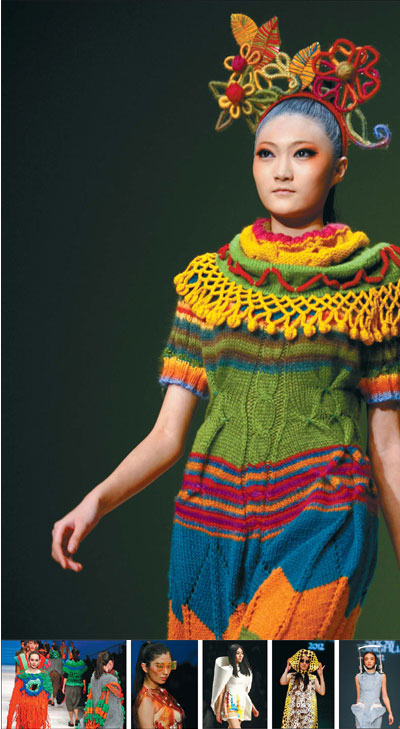
The 2012 China Fashion Week includes a project titled College Students' Fashion Day on April 1, showing the graduates' works from School of Fashion in Dalian Polytechnic University, Academy of Arts and Design in Tsinghua University, College of Garments in Wuhan Textile University and Art School of China Academy of Art (clockwise from top). Photos by Zhu Xingxin / China Daily |
Chinese design students are eager to find their way to the world's runways, report Tiffany Tan and Gan Tian.
Lan Yu had no idea a school fashion show would jump-start her design career. In her senior year of college, she created a ballgown-inspired wedding dress for the Beijing Institute of Fashion Technology's runway show at the 2009 China Fashion Week.
The piece, which featured hand-beaded detail on the bodice, won her that year's Young Designer Award, as well as recognition from fashion critics and local media.
Lan has since established her own wedding dress label. Her clients include mainland celebrities, such as TV host and actress Xie Na, who donned a one-shoulder, A-line gown when she tied the knot with singer Zhang Jie last fall.
Some fans call Lan "China's Vera Wang".
Nowadays, clothing companies head to school runway shows to scout for promising designers.
"I noticed there are many young talents showcasing their works at the fashion week," Ning Yunming, HR manager at Shanghai Donglong Feather Manufacturing Company, which makes down coats, said at the recently concluded China Fashion Week.
"I'm here to see if we can find someone interested in working for us."
After decades of being branded the "world's factory" - not to mention "copycat" - China is now cultivating original designs. Its eye is set on creating products and brands that will win the world, much like Apple, Louis Vuitton and Nike have.
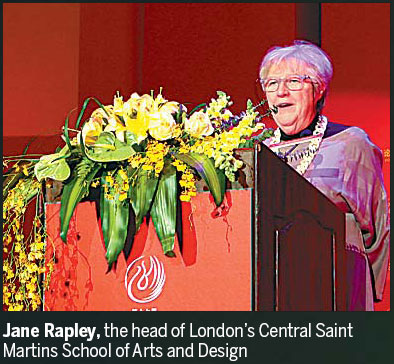
For this vision to materialize, Chinese design schools need to step up, says Jane Rapley, the head of London's Central Saint Martins School of Arts and Design, one of the world's top design schools.
"Something about your identity, your values and your lifestyle needs to appeal to the aspirations and dreams of the rest of the world, and that's what you need to market. And you need to educate your designers to find what it is," Rapley told an audience of some 200 during her keynote speech at last week's China Fashion Forum in Beijing.
"If you want to stand on the world stage, you need a pinnacle of creators who will be educated with more depth and more breadth."
What does that mean?
"Understanding that relationship between politics, economics, culture and product, and why at certain periods of time, certain ways of living were established," Rapley says on the sidelines of the forum, "and understanding that underlines the way you cut a collar. It's actually quite a big leap."
To achieve this, the professor says design schools need to encourage students to look beyond their fields and into the wider world - where consumers of all ages, colors, backgrounds, personalities and interests live.
"If they read newspapers, if they listen to contemporary music, whether that be pop music or contemporary classic, if they go to films, if they read books, if they listen to social debates, 'What is the population concerned about, interested in', that's the way they build up a tacit knowledge about what's happening around them.
"It will help them to design things - clothes, accessories, furniture, cars - that their target community wants to buy," says Rapley, who has been coming to China annually the past four years on business, including collaborating with Chinese design schools and judging fashion competitions.
But Chinese fashion design education, according to Rapley, has clearly improved since her first trip here in the late '90s. She attributes this to the greater flow of information between China and the world, through traditional and new media, as well as the growing number of foreign brands in the country.
"It's opened up that perspective, and where your local designers fit in the world. They've become much, much less parochial, inevitably, and I think excited by what they see, and responded accordingly," Rapley says.
Meanwhile, Chinese student designers are already winning over local fashion buyers because of their clothes' unbeatable value for money.
Last week's autumn/winter China Fashion Week included a College Students' Fashion Day, which presented collections from five of the country's top fashion design schools. Through these shows, audiences can tell each institution's preferences on fashion.
BIFT graduates, for example, use silk, embodiment, wash-and-ink elements, and colorful ethnic patterns, to present the modern Chinese dress. Tsinghua graduates focus on showing different modern high-tech materials used in garments. China Academy of Art graduates use more simple colors but more curves.
After the curtain fell, the pieces presented by Tsinghua University's academy of arts and design - garments made of high-tech materials - received a pledge from the Gucci Arts Education Fund. Kopenhagen Fur, one of the world's biggest auction houses for fur garments, also came knocking.
"Students' creations are often produced in a limited number, and their costs are lower than those from established designers and fashion labels," says Zheng Qiujing, who owns a fashion shop in Beijing and regularly attends local fashion weeks to check out student designs. "Some of them sell really well."
Contact the writers at tiffany@chinadaily.com.cn and gantian@chinadaily.com.cn.
|

|

|

|

|

|