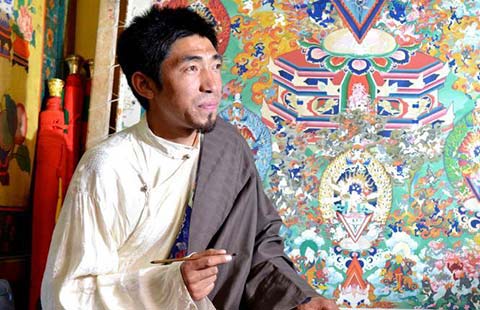
A thangka is a painting on cotton, or silk applique, usually depicting a Buddhist deity or scene. It often takes the form of a scroll banner but it is not flat, unlike oil or acrylic paintings.
In Tibetan thang means "to display", and ka means "silk", although most are painted on cotton.
A thankga consists of a picture panel that is then painted or embroidered. Generally, they last a long time and retain much of their luster, but because of their delicate nature they have to be kept in dry places where moisture will not affect the quality of the silk.
Thangkas served as important teaching tools that depict the lives of the Buddha, various influential lamas and other deities and bodhisattvas. One subject is The Wheel of Life, a visual representation of Abhidharma (art of enlightenment) teachings.
What is claimed to be the first thangka depicted the Palden Lhamo, the deity that protects dharma, and is said to have been painted by the Tubo king Songtsen Gampo (AD 617-650).
Between the 7th and the 9th centuries, the thangka style in Tibet was dominated by Paldre, a style from Nepal.
In the early 17th century, Choyang Gyatso, a great master and one of the disciples of the fourth Panchen Lama (1567-1662), created another style known as the Manluk Sarma style.
When the fifth Dalai Lama (1617-82) was expanding the White Hall of the Potala Palace, Choyang Gyatso was invited to undertake the important task of painting the massive frescoes.
The Manluk Sarma style remains popular today.
Copyright 1995 - . All rights reserved. The content (including but not limited to text, photo, multimedia information, etc) published in this site belongs to China Daily Information Co (CDIC). Without written authorization from CDIC, such content shall not be republished or used in any form. Note: Browsers with 1024*768 or higher resolution are suggested for this site.
License for publishing multimedia online 0108263 Registration Number: 130349