|
|

US President Barack Obama Visits China 2009
> Hot Topics
|
Warming up to a new climate of environmental stewardshipBy Chen Weihua (China Daily)
Updated: 2009-11-14 10:54
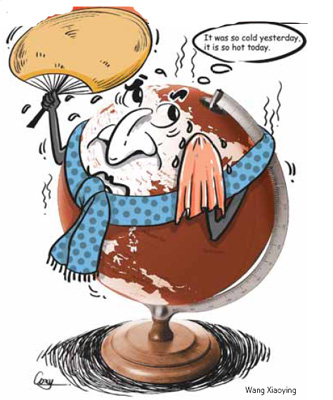 The climate change seminar held last week at the Asia Society in New York, which focused on China, was quite a surprise. The event included several US experts on climate change and several prominent scholars on China, such as Orville Schell, Jerome Cohen, Barbara Finamore and Andrew Nathan. I was expecting a lot of criticism of China's approach to climate change. Academics should be able to express their opinions on their area of expertise, whether they be negative or positive, without people taking undue offense. It is sometimes part of their job to analyze and critique, just as it is part of my job as journalist. However, the criticism of China I had heard at some previous seminars was over the top, and seemed based on a poor understanding of the situation, ideological inclination or a stereotyped Cold War mentality, instead of solid facts. So when Finamore, founder and director of the China Program of the Natural Resources Defense Council (NRDC) and Orville Schell, director of the Center on US-China Relations at the Asia Society and former dean of the University of Calfornia Berkeley, Journalism School, repeatedly mentioned China's progress on clean energy and carbon reduction, I was amazed. China was credited for its strong efforts in fighting climate change, particularly the government's plans to increase energy efficiency at power plants and other industrial buildings. President Hu Jintao's pledge at the UN Climate Change Conference in September that China will reduce its carbon intensity by a significant margin between 2005 and 2020 was highlighted, as was China's remarkable progress under the current Five-Year Plan in trying to reduce energy intensity by 20 percent between 2006 and 2010.
To be honest, few of China's 1.3 billion people are probably any more aware of the progress in their own country in fighting climate than most Americans. And I know China's problems in this area are still huge despite its efforts. The US took more heat than China at the seminar, and was criticized for a lack of leadership. While the US House of Representatives' approval of a climate change bill was applauded, the stiff opposition the bill faces in the US Senate was blasted. The recent protest in the US against a Chinese wind-turbine company's plans to supply equipment to one of the largest wind farm developments in western Texas was also criticized. But ultimately, the researchers and academics did not sit down to cheer for, or against, China, the US or Europe. They are pinning high hopes on the historic summit between visiting US President Barack Obama and Hu ahead of the UN Climate Change Conference in Copenhagen in December. Pushing for collaboration between the US and China was the key message of the seminar. The Asia Society, in partnership with the Center for American Progress and Monitor Group, recently released a roadmap for US-China collaboration on carbon capture and sequestration. The Natural Resources Defense Council, meanwhile, has put out several reports on special carbon capture projects in China. As the Chinese ambassador to the US, Zhou Wenzhong, told me and other reporters in Washington last week, the China-US relationship is now characterized by cooperation and dialogue in almost every field. The tone of the seminar appeared to support the ambassador's words.
|
       |
宁乡县| 文水县| 武邑县| 花莲县| 彭阳县| 海丰县| 上杭县| 邢台县| 河源市| 固阳县| 仁怀市| 闵行区| 德钦县| 固镇县| 尖扎县| 诸暨市| 石嘴山市| 泰安市| 大港区| 邵东县| 科技| 遂溪县| 综艺| 屏南县| 赤水市| 怀安县| 安乡县| 临泽县| 鄂尔多斯市| 海宁市| 钦州市| 石嘴山市| 仙游县| 新龙县| 怀柔区| 芜湖市| 名山县| 商南县| 北辰区| 武乡县| 高邮市|