|
|

G20 London Summit > G20 Summit
|
G20 leaders agree on supervisory body(China Daily)
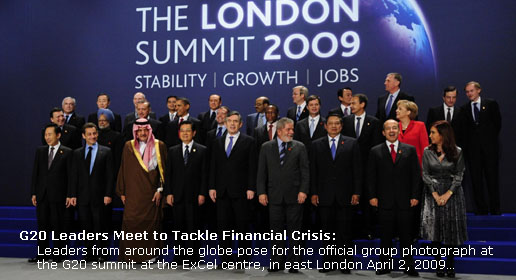
Updated: 2009-04-03 07:52 LONDON: The G20 leaders had agreed to create a new supervisory body to flag potential problems in the global financial system, British Prime Minister Gordon Brown said yesterday.
The summit host said the G20 will create a new financial stability board to ensure cooperation across frontiers, to spot risks to the world economy and - together with the International Monetary Fund (IMF) - provide "the early warning mechanism that this new global economy needs". He said it was essential that the world did everything necessary to "rebuild trust" and make sure "a crisis such as this" never happens again. G20 leaders agreed that blacklists of tax havens should be published and vowed to crack down on them. French President Nicolas Sarkozy and Brown said that Organization for Economic Cooperation and Development would circulate a list of countries that serve as tax havens.
Leaders like Sarkozy and German Chancellor Angela Merkel have been calling for tighter regulations on the banking sectors, which they believe are main culprits of the ongoing financial crisis. The leaders agreed "there will be an end to tax havens that do not transfer information on request. Banking secrecy of the past must come to an end", Brown said. Sarkozy said the results of yesterday's summit were beyond what could have been imagined. The global economy is expected to contract in 2009 by between 0.5 and 1.0 percent, according to the IMF, whose head, Dominique Strauss-Kahn, is calling it a "Great Recession". FSB calls for regulation The leaders yesterday agreed to establish a new Financial Stability Board (FSB) with a strengthened mandage as a successor to the Financial Stability Forum (FSF). The forum of leading central bankers and regulatory bodies yesterday also joined the call to regulate lenders. It said that bonuses at banks must be supervised this year to try to discourage risky investments that helped bring several companies to the brink of bankruptcy. Banks would have to put aside more and higher quality capital to provide a cushion against potential losses, it said. "Compensation practices at large financial institutions are one factor among many that contributed to the financial crisis that began in 2007," the FSB said in a policy document. "High short-term profits led to generous bonus payments to employees without adequate regard to the longer-term risks they imposed on their firms," it said. FSB members - which include all G20 members, Spain and the European Commission - must commit to applying principles agreed by the forum, which become effective immediately. The FSB has drawn up principles on remuneration for national regulators to apply. They were presented at the summit to apply lessons from the financial crisis. There has been public outcry in the United States, Britain and elsewhere over bonuses, especially those given by banks that received taxpayer money to stay afloat. One principle says the board of a bank must actively oversee how compensation schemes are designed and monitored. "Authorities expect evidence of material progress in the implementation of the principles by the 2009 remuneration round," the FSB said. The FSB proposals also detailed planned changes to bank capital rules and how national supervisors cooperate. The FSB said the global Basel Committee on Banking Supervision would put forward a raft of draft changes to bank capital rules before the end of 2009 for consultation. The Basel Committee's Basel II standards have been criticized for being pro-cyclical or exacerbating crises. The Basel Committee will propose a simple ratio to contain bank leverage as a supplement to its current "risk based approach" to determining capital requirements. Banks would also have to build up buffers in good times to be run down when markets turned sour and avoid the need for huge taxpayer bailouts. "They will be implemented over time once conditions in financial markets return to normal," the FSB said. The FSB also published principles for supervisors, central banks and finance ministries to cooperate in making advanced preparations for dealing with financial crises and in managing them when they happen. The authorities from different countries would commit to meeting regularly alongside core supervisory colleges that the G20 wants set up for each major cross-border financial institution to spot problems earlier and intervene quickly. "The FSB will act as a clearing house for experiences in information sharing and contingency planning for the benefit of its members," the FSB said. China Daily, AP and Reuters |
       |
泰来县| 于都县| 屏南县| 永修县| 安义县| 辽中县| 尼勒克县| 拜城县| 富民县| 黄石市| 文成县| 额尔古纳市| 泸溪县| 通化县| 柯坪县| 邹城市| 奉贤区| 城固县| 宁波市| 乃东县| 温州市| 姚安县| 杨浦区| 阿坝县| 高平市| 东莞市| 客服| 锦屏县| 兴隆县| 平邑县| 山丹县| 泰来县| 始兴县| 泾阳县| 北宁市| 清丰县| 宜宾县| 同德县| 卢龙县| 丹阳市| 团风县|