China to pass on ethnic sports treasure
Updated: 2011-09-17 18:20
(Xinhua)
|
|||||||||||


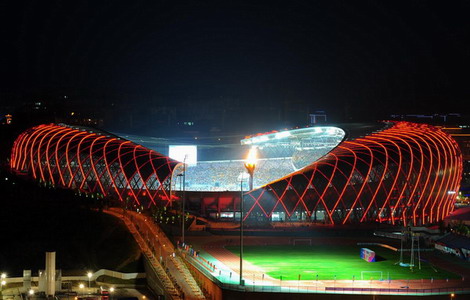
GUIYANG, China - Beijing Olympic champion Zou Shiming walked through a digital "Fire River" and climbed up a broadsword-ladder before he lit the main cauldron, showing the organizers' courage and determination to hold a successful Ethnic Games in Guizhou.
The same courage and determination are also shared by the country that committed itself to preserve and pass on ethnic sports treasure from the 56 nationalities in China.
"With the scale of Ethnic Games increasing edition by edition, we are facing new challenges," said Tondrub Wangbum, vice minister of the State Commission for Ethnic Affairs, in an interview with Xinhua.
"We should not only focus on the numbers but also on the quality of the ethnic events. We need to largely improve the level of title events and demonstration events alike to help the Ethnic Games develop in a healthy way."
The country's first Ethnic Games was inaugurated in 1953 in Tianjin, North China's important port city. And it was also the first ever multi-sports event of the world's most populous country.
After an abeyance of 29 years, the second games was held in Hohhot of Inner Mongolia in 1982. Since 1991, it was regulated to be held every four years.
Different from other multi-sports national games of China, the quadrennial sports and culture gala includes no Olympic sports on the program but fit up the most with the Olympic spirit, which emphasis for the cultural differences and mutual understanding.
It gathers the 55 Chinese minority groups, which account for about 8.49 percent of the country's population of 1.37 billion besides the largest nationality the Hans, and has long been reckoned as an important presence in maintaining the 55 ethnic groups' own rich traditions and cultures.
With a biggest ever participation, the ninth Chinese Traditional Games of Ethnic Nationalities has assembled over 6,700 athletes for a total of 16 medal events and 186 demonstration events. And most of the events take their source from daily life of the specific nationalities.
"The ethnic sports come from the grassroots, and many of them are still to be sorted and arranged," said Tondrub Wangbum. "Our work need to be focused on two spheres. First, we need to realize the importance and potential of these ethnic culture treasure while try to inherit, preserve and develop them. And secondly, we need to introduce and promote such sports to the public, which we have already been working on in some areas of the country. For example, some ethnic sports have already been introduced to schools and colleges."
The traditional Yi folk show "Axilixi" is a demonstration event in the on-going Games in Guiyang, capital city of Guizhou. It is the combination of singing, dancing and sports and has been selected as a culture course in local middle schools in Guizhou's Bijie area. All the performers of the "Axilixi" show in the Games come from the Ethnic Middle School of Hezhang County in Bijie and most of them are students.
"Our performances are warmly-welcomed, which encouraged the students a lot," said Wang Enguo, an adminstration staff from the school who also took part in the "Axilixi" show in Guiyang. "The National Ethnic Games is really helpful for the introduction and promotion of ethnic culture and sports events. It provides a platform to show the charm of these culture treasures."
"We are teaching our culture to the youth in classroom. Like in the PE course which I used to taught, we teach them traditional ethnic sports like the Yi-style wrestling, top-flipping and swing, " Wang added.
Like the Wang's school, a lot of elementary and middle schools in China have included ethnic sports into their curriculum. ?And specialities of ethnic sports are also established in the Minzu University of China and Beijing Sports Universities.
According to Tondrub Wangbum, some dancing-related demo events can also be promoted into the national fitness project and exercised by the public in parks and squares.
In 1995, China adopted the "Physical Health Law of the People's Republic of China". In the same year, the State Council issued the "Outlines of Nationwide Physical Fitness Program", pledging a sports and health-building service system for the general public.
And now the Chinese people will have more options in terms of sports activities as a lot of ethnic sports like top-flipping and stilts-walking are all available for choose.
"In most of China's ethnic areas, ethnic sports play an important part in public fitness program," said Tondrub Wangbum. "Now, regional ethnic games are regularly held in 26 provinces, municipalities and autonomous regions in China. And in some area, ethnic sports are even featured in local games together with Olympic sports."
"Strengthening the people's physique has always been put among the priorities of China's government," said Tondrub Wangbum. "China develops modern sports in ethnic areas and meanwhile preserve and sort traditional ethnic sports. The increasing scale of Ethnic Games can well reflect the fast-development China's ethnic sports," said an optimistic Tondrub Wangbum.


Hot Topics
Organ transplant bonds mother and son
Editor's Picks
|
|

|
|
|
|