 |
|
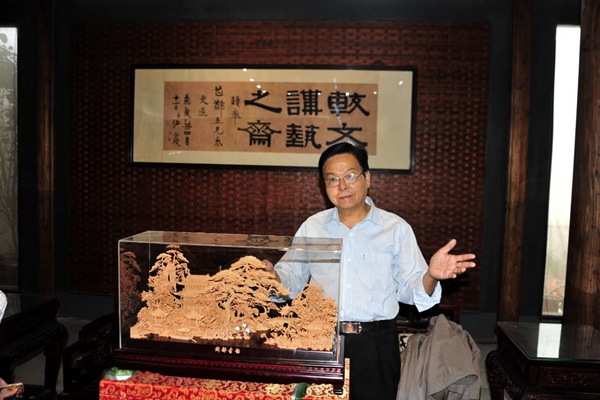
Wu Zhisheng shows one of his works to reporters in Fuzhou city, Fujian province, Nov 17, 2015. [Photo by Huang Shengyou/for chinadaily.com.cn] |
Known as one of the "Three Treasures of Fuzhou", cork cutting awaits wider recognition and greater support in handing down the craft as its practitioner struggles to pass on the art today.
The art first originated in 1914, invented by Wu Qiqi of Xiyuan village, Fuzhou, capital city of Fujian province. Cork cuttings are made with the bark of cork oaks found in Europe. With various carving techniques, the cork bark is engraved and carved into flowers, trees, pavilions, trestle bridges and boats, making a "three-dimensional painting".
Delicate and beautiful as it is, the handicraft is often referred to as "a silent poem."
Fuzhou cork cuttings sold well overseas in the past century. They were often used as screens, hanging pictures, ornaments and other decorations for the rich or in foyers of big hotels.
The cutting techniques used to be mastered by thousands of people in Xiyuan village when its business thrived in the 1970s and 1980s.
"During the 1990s, the industry began to fade rapidly as the country's exports encountered a sharp decline," said Wu Zhisheng, the fourth-generation inheritor of the folk art, also a descendant of Wu Qiqi.
"Many craftsmen turned to other jobs to make a living," Wu said, "And factories shut down one after another."
Though faced with hard times, Wu never gave up. He even sold newspapers and his wife opened a grocery store to raise money for the revival of the industry.
In 2002, Wu opened a creation center for cork cutting to encourage the practice of the art.
Things began to improve after 2005 when the government began to provide more support for this art. Wu started a company the next year to train more professional craftsmen in a working studio.
In June 2008, cork cutting was listed as a state-level intangible cultural heritage in China.
"As the business environment has changed, I tried to innovate in the industry, " he said, "I made more exquisite packages for the products and expanded more distributing channels."
Now the cork cuttings can be seen at tourists sites, weddings, birthdays and temples.
Though the industry has seen signs of recovery, Wu worries about passing down the art of cork cutting.
"Now there are only about 20 people who have mastered the techniques but most of them are over sixty," he said. "What if they retire?"
Bearing the question in mind, he cooperated with local art schools to provide courses about cork cutting, in order to attract young talents. He even gave training to prisoners to find potential inheritors.
It takes at least three years for an apprentice to master the techniques, according to Wu. He wishes to break the old ways of teaching and found academies to attract more people.
"There are still challenges because it cannot offer a high salary," he said, "I hope our project can get more funding in the future."
"Only when the young people are interested, will there be a future for cork cutting," he added.


Copyright 1995 - . All rights reserved. The content (including but not limited to text, photo, multimedia information, etc) published in this site belongs to China Daily Information Co (CDIC). Without written authorization from CDIC, such content shall not be republished or used in any form. Note: Browsers with 1024*768 or higher resolution are suggested for this site.
License for publishing multimedia online 0108263 Registration Number: 130349