A: The CPC advocated adopting a line of total resistance against Japanese aggression by the whole nation. On July 8, 1937, the day after the July 7th Incident, the CPC Central Committee issued a telegram declaring, "A war of resistance in which the whole nation takes part is the only way out."
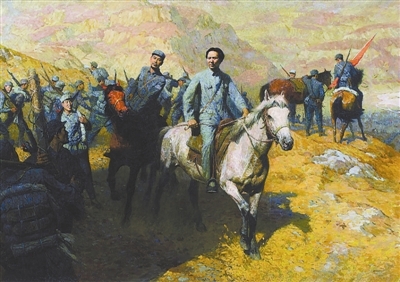
Between August 22 and 25, the Central Committee called an enlarged meeting of its Political Bureau. At the meeting, it was formally decided that total resistance by the whole nation was the line to be taken. In the "Ten-Point Program for Resisting Japanese Aggression and Saving the Nation" adopted at the meeting, this line was elaborated in detail. The main points included bringing down Japanese imperialism; mobilizing armed forces all around the country; mobilizing the people; reforming the government apparatus; adopting a counter-Japanese foreign policy; adopting wartime financial and economic policies; improving the people's living standards; adopting a resistance-related education policy; weeding out collaborators, traitors and pro-Japanese elements, and consolidating the rear; and achieving national unity against Japan. The CPC's line was, in essence, one of waging a people's war.
In addition to the right line, the right strategy was also essential for securing victory. The CPC decided on its fundamental strategy of carrying out a protracted war.
In order to implement the line of total resistance by the whole nation and the overarching strategy of carrying out a protracted war, the CPC Central Committee and its Military Commission adopted a new military strategy for the people's army, taking into account that the army was poorly equipped and its troop numbers were limited.
Mao Zedong proposed that the people's army should engage in independent guerrilla warfare in the mountainous regions and that it should, when conditions were ripe, seek to defeat enemy units and engage in guerrilla warfare on the plains.
The new military strategy required the people's army to transform the way it did battle. It was now to engage mostly in guerrilla warfare to resist the Japanese and no longer engage in regular warfare in civil war. The strategy also demanded that organizationally, the people's army be transformed from a regular army employed in concentrated units to a guerrilla army employed in dispersed operations.
Mao predicted that during the final stage of the war, which for the Chinese would be a period of strategic counter-offensives, military strategy would again need to be changed, this time from mainly guerrilla to mainly regular warfare.
He also argued that there would be three stages to the protracted war. Each of these stages was, in its own right, to be protracted. The first stage, according to Mao's analysis, was to be a period of strategic offensives by the enemy and strategic defense by China; the second was to involve strategic consolidation by the enemy, and Chinese preparations for making counter-offensives; and the third would be one of strategic counter-offensives by China and the enemy's retreat. China, he predicted, would gain the power to swap weakness for strength during the second stage of the war, and that was what would secure its victory.



Copyright 1995 - . All rights reserved. The content (including but not limited to text, photo, multimedia information, etc) published in this site belongs to China Daily Information Co (CDIC). Without written authorization from CDIC, such content shall not be republished or used in any form. Note: Browsers with 1024*768 or higher resolution are suggested for this site.
License for publishing multimedia online 0108263 Registration Number: 130349