|
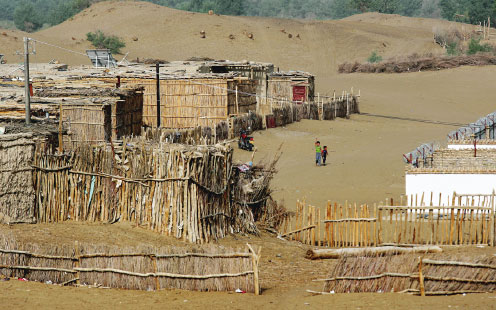
Local people use the wood of the desert poplar to build houses in Daliyabuyi, Hotan prefecture, the Xinjiang Uygur autonomous region. It's prohibitively expensive to transport building materials to the desert township because it is not connected to the outside world by road. Photos by Wang Zhuangfei / China Daily |
Modernity arrives
Through the gaps in the tree branches that serve as walls, almost everything is on display in Memet's traditional house: the sheepskin on the floor that allows the family to wipe sand off the soles of their feet, a shiny fridge and photos of traditional English gardens that hang on the walls as decorations.
The houses may look shabby, but they provide perfect ventilation and are cool inside even when the desert absorbs the fierce summer heat.
"Life in the desert is not as harsh as people think. It can be modern too," Memet said, gently patting the fridge he bought in June after the township government installed new batteries to store the excess electricity generated by solar panels and provide constant electricity. When he bought the fridge, Memet abandoned his old "vegetable cellar" - a deep hole he dug in the backyard - and it's now completely filled with windblown desert sand.
Daliyabuyi is 267 km north of Yutian, the county seat, but there are no roads in the desert. Apart from the locals, only skillful drivers, such as Rejef, can take visitors to the township. Rejef's customers include Azez, other township officials and people who are curious about this "Shangri-La of the Taklimakan".
Getting to and from Daliyabuyi remains a challenge, though. The journey takes 10 hours in Rejef's SUV - the fastest means of transportation - but the same trek takes a whole day by motorbike or a week by camel.
The 48-year-old Yutian native knows the desert like the back of his hand and the SUV easily scales the six mountainous sand dunes on the way to the township. The dunes are forcing the river to change its course, and the shifting sands have already raised a section of riverbed above the water level.
"In 1986, it took me 15 days to get to Daliyabuyi in a truck, and I clearly remember that there were only two big sand dunes on the way. The area where people can herd animals has become smaller over the years, but the population has grown," Rejef said, shifting gears as the SUV climbed a dune. "It's more like sailing in the desert than driving."
The Keriya people always stand outside their houses when they hear the sounds of vehicles approaching. They always check to see if the travelers need help and offer them cups of herbal tea.
The part of the Taklimakan nourished by the Keriya River is full of life, including China's biggest forest of wild desert poplars, whose leaves turn golden in autumn. The local government has announced that it will build a 90-km-long road to the forest to attract tourists, but Rejef was unimpressed. "It will quickly be eaten up by the desert," he said.
Tohutroz Memetmin has been head of Daliyabuyi for three years, but the 40-year-old Yutian native still can't get used to the rough and sometimes dangerous journey from the county seat. "During the flood season around July and August, no vehicles can get in, so the township is completely sealed off. Also, sandstorms during the journeys can be life-threatening because there is no mobile reception along the way."
Although there is no coverage in the desert, solar-powered mobile-signal towers have been built in the compound of the township government to connect Daliyabuyi with the outside world. The offices are actually mobile homes, which are cheaper than buildings and easy to move. "No one can afford brick houses here because the cost of transporting bricks is too high, and who knows how many bricks will actually survive the journey. Our offices are unique among government buildings in China," he said.
"The people here are very honest and always look out for each other. There is no violence or terrorist crime here," Tohutroz said. Actually, there was no recorded crime in Daliyabuyi until last year, when 21 locals were arrested for stealing cultural relics from an ancient city buried by the desert and selling them illegally. "They wanted to get rich and move out of the desert," he said.
Copyright 1995 - . All rights reserved. The content (including but not limited to text, photo, multimedia information, etc) published in this site belongs to China Daily Information Co (CDIC). Without written authorization from CDIC, such content shall not be republished or used in any form. Note: Browsers with 1024*768 or higher resolution are suggested for this site.
License for publishing multimedia online 0108263 Registration Number: 130349