 |
|
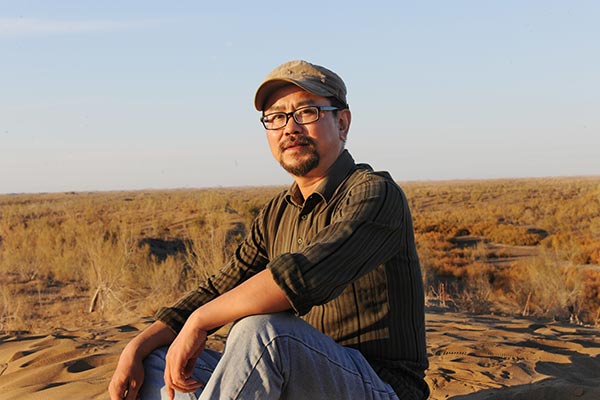
Poet Shen Wei focuses his writing on the Xinjiang Uygur autonomous region, where he has lived for 27 years. [Photo provided to China Daily] |
A Dictionary has an entry called "Migrant Frog". It is a short fantasy story of a frog from the southern China. The frog feels depressed because he is always wet from being inside a pond, so he hops to the deserts of Xinjiang in the hope that the water on his skin will evaporate.
"As a southerner, I felt like that frog," Shen says. "But the frog also had to retain the humidity of his skin, or he would die. ... So, I needed to dry myself a little bit. But at the same time, I had to keep myself wet enough. I think my writing injects a little bit of humidity into dry Xinjiang, which is a metaphor in A Dictionary."
Shen says that one of the biggest reasons he stayed in Xinjiang for so long is his body's tolerance of the region's strong foods and sunshine.
"Only if one's body accepts a place can his or her soul gradually accept that place," he says.
He Yanhong, a professor of literature at Shanghai Jiao Tong University, says it was good that Shen went to Xinjiang. The region benefitted from his writing and he gained from its creative inspiration and resources.
Shen describes his poems on Xinjiang as a "castle of language" and his collection of essays as a "small house near the castle" through which one can enter the region.
A Dictionary can also serve as a book that introduces the region's scenic spots, such as the Tianshan Mountains and Tianchi Lake.
"You can see the spirit of those places through the author's eyes and minds. So the book is more profound than a tourist guide," says He, the professor.
Shen takes poetry as the highest goal of his writing and hopes readers can take the poetic meaning of his expressions from A Dictionary.
As an East China native living in Xinjiang for the past 27 years, Shen describes Xinjiang in a way that's different from native poets and authors.
"I use a dozen styles ... including prose, fairy tales, stories, diaries, letters and so on," he says.
"I am trying to look for literary expressions amid the multicultural background. Mixed cultures are brilliant and vigorous cultures, like those of the ancient Silk Road."
Literature deals with love, pain and death-themes that are universal and go beyond borders and races, according to Shen.
"What we, the writers of Xinjiang, need to do is to break down regionalism and represent universal human nature in our works."
Related:
Hugo Award to open new chapter for Chinese sci-fi
10 literary works on World War II
Related Stories
Copyright 1995 - . All rights reserved. The content (including but not limited to text, photo, multimedia information, etc) published in this site belongs to China Daily Information Co (CDIC). Without written authorization from CDIC, such content shall not be republished or used in any form. Note: Browsers with 1024*768 or higher resolution are suggested for this site.
License for publishing multimedia online 0108263 Registration Number: 130349