Global city planners compare notes in Guangzhou
 |
|
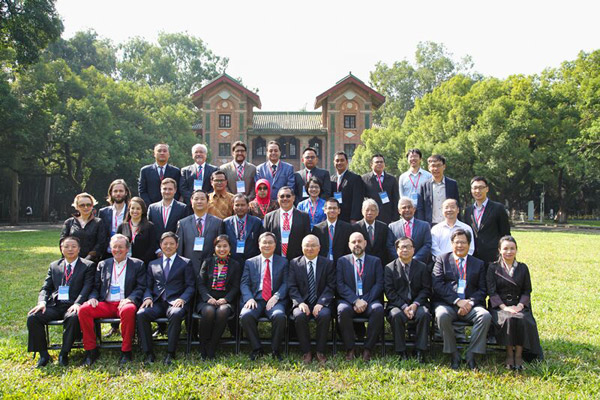
Participants of the 2nd Workshop for Thought Leaders take a group photo in Sun Yat-sen University, Guangzhou, on Oct 30. [Photo provided to chinadaily.com.cn] |
Recently more than 30 city planners and experts from across the globe gathered in Guangzhou to share their experiences and brainstorm innovation on urban governance at the second Workshop for Thought Leaders.
Global thinkers in attendance discussed cutting-edge technologies and shared experiences in peer transport projects from across the world in a bid to help governments to design and implement high quality transport systems and policy solutions that make cities more livable, equitable, and sustainable.
"For Guangzhou it is very challenging, trying to protect the city's heritage while at the same time looking to the future," said Octavio de la Varga, Secretary General of the World Association of the Major Metropolises (Metropolis). His first visit to the city was in December, 2016, where he took part in the third Guangzhou International Award for Urban Innovation and toured the city's many arcades, the Guangzhou Theatre and Guangzhou Museum.
Metropolis is working on the development of governance of metropolitans, but the models vary a lot from city to city, according to de la Varga.
"Currently, a lot of cities are committed to building a metropolis, but there is not a specific pattern for all, nor a perfect pattern", said de la Varga.
Dr. Lee W. Munnich, senior researcher of University of Minnesota, is a veteran expert on urban transport systems, who started to research traffic-congestion charging systems in the 1990s and whose study prompted the legislation of a high-occupancy-toll (HOT) lane in Minnesota as early as in 2003. It has led to the development of MnPASS Express Lanes in the Twin Cities metropolitan area (Minneapolis and its neighbor Saint Paul).
At the workshop, Munnich shared the successful implementation of the MnPASS system where the local government designated three Express Lanes in 2005, 2010 and 2015. During peak-travel times, motorcycles, and vehicles with two or more occupants including children or infants may drive in the designated MnPASS Express Lanes for free. Solo motorists who have a MnPASS account and a MnPASS tag must pay a fee to drive in the MnPASS Express Lanes during peak-travel times. Drivers can quickly receive traffic information via a MnPASS tag – an electronic device placed on the inside of the windshield. The MnPASS system has largely reduced traffic congestion in the Twin Cities metropolitan area.
Munnich spoke highly of Guangzhou's BRT project and said he was impressed by innovative technologies in mobility systems as well as the popularity of the bike sharing system in the southern Chinese city.
Munnich reiterated the importance of courageous leadership in solving traffic congestion issues in a big city or mega city in order to further improve livability.
"Metropolises like Guangzhou should prepare for change in the future, there will be a transition to driverless vehicles," Munnich added.
Education key to innovation
Voicing her concerns that innovation starts with education, Bernadia Irawati Tjandradewi, Secretary General of the United Cities and Local Governments Asia Pacific (UCLG-ASPAC), said "The environmental education level is not in parallel to people's education level. People have PhDs, masters or bachelors, but their environmental education could be very poor."
Bernadia suggested that energy-saving systems should be employed in public buildings since there are a lot of public buildings in the city, which could help to improve air quality and reduce greenhouse gas emissions.
"I like to start with the small things; they lay foundations for the big ground," said George Ferguson, former mayor of Bristol, speaking of the UK city's practice in building a green city. "These little things help change the culture for people, for the children to understand how important it is for the city environment and how important it is for their own health."
The former Bristol mayor emphasized the great value of children's education, "They (children) start to educate their parents and get them to accept those small projects."
In 2015 while in office as mayor, Ferguson helped Bristol become the first UK city to be named a European Green Capital since the awards were established in 2010. The city was chosen not only for its green spaces and easy access to the countryside, but for its enthusiasm for all things sustainable.
Ferguson introduced "carrot and stick" policies to encourage people to share their cars, reducing the use of cars in a bid to build a green city.
He advocates streets should be free of vehicles, gaining people an opportunity to see their communities in a different way.