Authorities move against shared bike 'congestion'
|
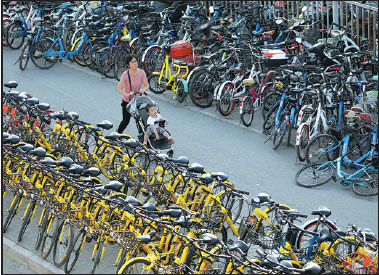
A woman pushes her child along the road between lines of bikes blocking a sidewalk in Beijing.Zhu Xingxin / China Daily |
Fierce competition
Data supplied by the Ministry of Transport show that about 70 companies are providing more than 16 million shared bikes across the country. The fierce competition means that many operators flood areas with cycles in the hope of outflanking their rivals.
The problem is now acute and the sheer number of bikes on the streets has led to numerous complaints about illegal and thoughtless parking.
In December, a report published by the Shanghai Consumer Council said more than 50 percent of people questioned complained about shared bikes blocking sidewalks, causing disorder in their neighborhoods and illegally occupying parking spaces earmarked for private cycles.
In August, the Shanghai Municipal Transportation Commission stopped companies from introducing new bikes onto the streets because "they dominated sidewalks and lanes intended for non-motorized vehicles, obscured the stippled paving slabs used to guide blind people and harmed the urban traffic order and the city's image".
More than 10 cities, including Beijing, Fuzhou, Fujian province, and Guangzhou and Shenzhen in Guangdong province, quickly followed suit and announced similar bans.
Shared-bike operators in Shanghai said they are in close communication with the authorities in every part of the city and always try to cooperate with them to minimize any negative impact.
"We have employed full-and part-time staff to work at more than 300 hot spots in the city to ensure the bikes are parked correctly and transport them to other districts when some areas become overcrowded during rush hours," Ofo said in a written statement to China Daily.
Some cities have imposed detailed regulations. For example, in Shenzhen, at least five people for every 1,000 bikes must be employed to regulate the number in each district in addition to ensuring that they are maintained and repaired when necessary.
Unintended consequences
Despite general public approval, the removal of the bikes has resulted in the revival of the illegal motorcycle taxi trade at hot spots in some cities, according to the industry insider.
Yan Dawei, an operations manager for Ofo in Shanghai, said one of the benefits of the shared bike system has been the disappearance of illegal motorcycle taxis, a long-term problem in the city.
"There always used to be about 50 illegal motorcycle taxis outside the subway station at the Zhangjiang High-Tech Park, but their business declined because of our bikes, so many of the operators came to ask if they could work for us. More than 20 later joined our teams that ensure the bikes are parked safely," Yan said.
Solutions
Yan added the cooperation between the government and the bike operators has become more effective since the authorities began providing information about traffic plans during major social activities and holidays.
"For example, before the National Day holiday week from Oct 1 to 8, the Huangpu district government informed us of specific areas along the Bund that would be particularly crowded so we could prevent illegal parking. We provided enough staff to prevent any problems occurring," he said.
Xu Yongsheng, who is in charge of operations for Ofo in Pudong New District, said the local traffic authority gives the company notice of events, such as large conferences, music festivals or sports games, to provide ample time for preparations to be made.
"Usually, there isn't a lot of traffic around these venues, but if there is an event, many people swarm in on shared bikes," he said.
Mobike said one of the ways it prevents congestion is by moving the bikes from the downtown areas to outlying districts.
In total, 36,000 Mobikes have been moved from districts such as Jing'an, Xuhui and Changning in the downtown to suburban areas such as Chongming, Jiading and Jinshan, according to Zhu Qian, the company's director of government affairs in the East China region, in an interview with Jiefang Daily in Shanghai.
However, some users said demand in areas where the government believes the number of bikes surpasses market need is not being fully satisfied.
"If I get out of the Xinzhuang Subway Station after 7 pm on a workday, there won't be a single bike available," Lin said.
"I hope the government will provide more parking spaces on the streets and near office buildings so the number of bikes will rise and more people will be willing to leave their cars at home and cycle around the city."