Coral scientist sees new tide of hope to protect Hainan reefs
|
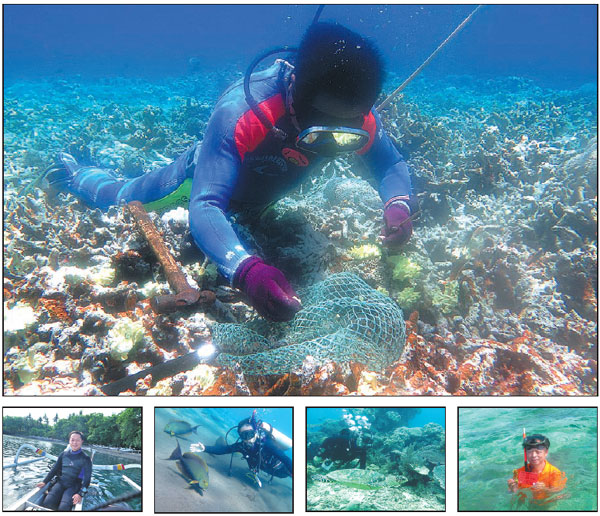
Top and right: Chen Hong, director of the Hainan South China Sea Institute of Tropical Oceanography, grows coral seedlings in waters around the Xisha Islands. While above, from left, Chen at work during a survey of reefs in Indonesia. Provided to China Daily |
Restoration of the precious resource and ensuring its survival is Chen Hong's lifetime mission
What lies beneath has intrigued Chen Hong since childhood and he has devoted his life to exploring the mysteries of the seas, especially the "lungs of the oceans", coral reefs.
"Look, these are coral seedlings we planted in Xisha in April 2014. They are growing fast," said Chen, a 52-year-old oceanic scientist, showing recently taken pictures, smiling like a veteran collector who has struck gold.
"After more than 10 years of experiments, we have mastered at least six kinds of technology for growing coral under different environments and the survival rate of corals such as goniastrea (resembling a sponge) is as high as 90 percent," Chen, director of the Hainan South China Sea Institute of Tropical Oceanography, said at his new 1,500 square-meter laboratory at Yazhou Bay, Sanya.
Coral reefs are the forest of the ocean and are at the top of the biodiversity system where almost all kinds of living marine categories have representative species living among them.
Charles Darwin, the father of modern biology, described coral as "one of the most wonderful things in the world". Healthy reefs attract fish, algae and other marine life forms, gradually evolving into a biological supermarket and eventually "an undersea city".
Reefs account for less than 0.25 percent of sea area, but shelter and nourish more than one quarter of the oceans' fish resources.
"Global warming, land-based sewage, illegal fishing activities, wild multiplying of thorn starfish predators and too much tourism are threatening the coral reef ecosystems. My heart was broken seeing many of them turning white in response to stress," said Chen.
He explained that as sea temperatures rise, zooxanthellae parasitic plants, vital for the coral's survival, are expelled.
Without zooxanthellae, bleaching occurs and the reefs will die.