Nation focuses on 'innovation ecosystem'
China will finish building the foundation of its national technology transfer system by 2020 and release a complete version by 2025, according to a recently released government paper.
The State Council published an outline for the system on Tuesday, saying it aims to facilitate innovation and economic development across regions, help turn scientific research into products and transform China into a science and technology powerhouse.
"This is the first time technology transfers have been examined thoroughly and systematically at a national level," Xu Jing, director of innovation and development for the Ministry of Science and Technology, said on Wednesday.
The outline examines the role of China's main innovators - companies, universities and research institutes - and the climate they face in the policy, legal, institutional and market realms.
Xu said the outline will be a "blueprint for building a national ecosystem of innovation" that can adapt to market changes. It will also provide possible solutions to issues that can limit the efficiency of technology transfers, such as the allocation of research resources.
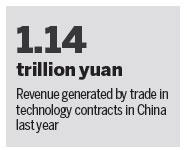
China's trade in technology contracts generated 1.14 trillion yuan ($171 billion) last year, up by nearly 16 percent year-on-year. It is the first time the country has passed the 1 trillion yuan mark, Xu said.
In the first eight months of this year, the technology trade was worth about 532 billion yuan, a 14.4 percent increase over the same period last year.
As of 2016, the Ministry of Science and Technology had registered more than 4,290 innovation spaces and 3,250 incubators nationwide. Last year, they served more than 400,000 companies, created more than 2 million jobs and attracted 93 billion yuan in investment, Xu said.
Yet as trade booms, more institutional and legal issues emerge, he added. For example, companies, universities and research institutes often operate within their own institutional boundaries and have trouble communicating or cooperating with each other.
Technology transfer is not a major part of the evaluation process for scientists looking for a promotion; publishing scientific papers gets more emphasis. However, Xu said, the outline encourages universities to focus more on technology transfers, and motivates scientists to think how their research can benefit the public.
State-owned companies and research institutes also often have a hard time adapting to provincial policies due to structural limitations, so the outline will launch pilot zones to test the effectiveness of new policies, he said.
At the same time, governments should provide stronger support to help innovators navigate market and policy changes, he added.
Zhang Zhihong, head of the ministry's Torch High-Tech Industry Development Center, predicted the new system will provide a more unified and open exchange network for technologies.
"The national technology transfer system will facilitate cooperation and investment across regions, disciplines and markets," he said.