A green oasis raising incomes
 |
|
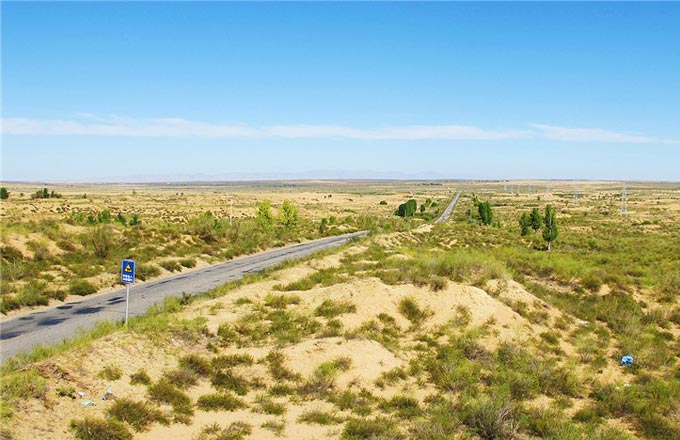
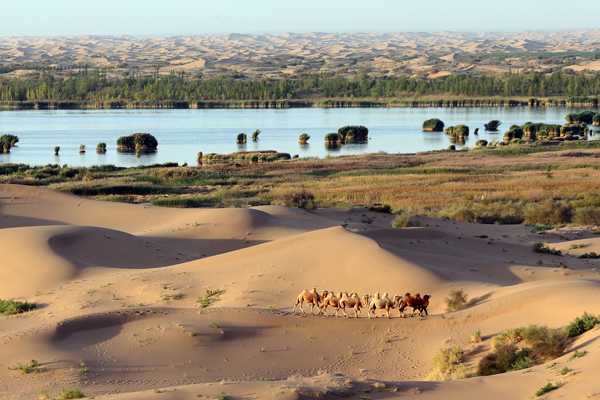
The Kubuqi Desert in Ordos, Inner Mongolia autonomous region, is rapidly becoming covered with trees. [Photo/Zou Hong] |
Life in a desert is the polar opposite of depictions in movies and photo collections in which groups of merchants swathed in white robes sit on the backs of camels and sway gracefully back and forth across golden sand dunes.
In most instances, living in a desert means a constant struggle against hunger and poverty, maybe for an entire lifetime. However, in one small village in the Inner Mongolia autonomous region in North China, the people of the desert have refused to accept this fate. In the past 40 years they have achieved a mission impossible-"greening" the desert to make it habitable for generations to come.
Li Hua is village head of Udon Qaidam in Ejin Horo Banner, Ordos. The 55-year-old has never forgotten how tough life was during his childhood on the edge of the Maowusu Desert. In the 1970s, nearly all of the village land-1,130 hectares-was covered by sand. Just 8 percent was green and suitable for cultivation.
The residents found it difficult to develop any form of agriculture, so their staple foodstuffs were powdered corn and sweet potatoes. No one in Udon Qaidam ate cucumbers or cabbages until the early 1990s.
A harsh life
In the 1970s, strong winds hit the village frequently. "Most of the cottages were about 3 meters high. Sometimes, after a windy night, we couldn't even open the door because it was blocked by the sand outside," Li said. "It was hard to feed a family, not to mention earn any money. I have a younger sister and a brother, and they wore clothes passed down from me. None of us had shoes."
More than half the village's residents gradually moved to other places, but Li's father-Li Mingliang-insisted on staying. "My father was the head of the village. He said that if we all left, the only area of vegetation would rapidly disappear," Li Hua recalled.
In the 1970s, Li Mingliang led a tree-growing drive among the villagers, using a national policy that provided subsidies of 30 to 50 yuan for every 0.01 hectares planted with trees. By 1984, 24 percent of the land had been reclaimed from the desert and was green with vegetation.
In 2000, the villagers elected Li Hua to succeed his father as village head. He immediately started using innovative measures to expand the area of greenery and raise people's incomes. "Used rationally, trees and other desert plants can also be turned into sustainable resources," he said. In recent years, he has continued to expand the area of greenery and has brought in a number of companies that process the plants into raw materials for furniture and other items.
In 2005, Li Hua launched a pilot project to plant 0.6 hectares of Mongolian Scots pine trees. By 2012, the trees, which had grown to 3 meters, were sold for 200 yuan each. The sale generated 1 million yuan, a sum the villagers found hard to comprehend.
Between 2000 and 2008, the annual per capita income in the village was 1,300 yuan. By last year, the figure had soared to 13,000 yuan, and the forest covered 75 percent of the land, while grass covered 95 percent.
Li Hua has a bigger plan for next year; he wants to consolidate each family's land rights and attract companies to use it further. The villagers will become shareholders in, and workers for, the companies.