'Mars Village' for tourists, not astronauts
 |
|
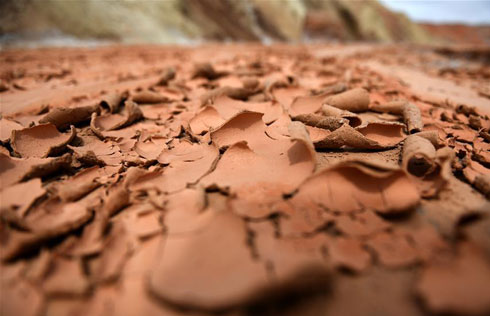
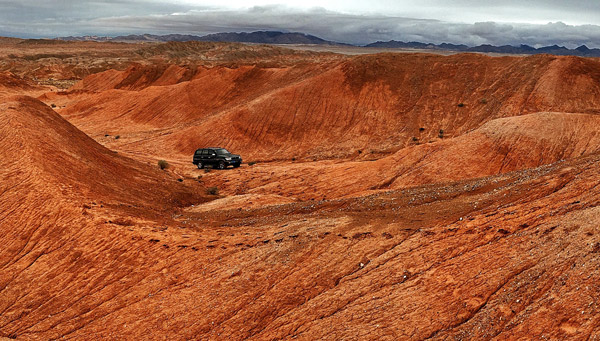
The site where China's first Mars simulation base will be built in Qinghai province mirrors similar features of the red planet. [Photo/Xinhua] |
China will finish building its first Mars simulation base in Northwest China for ecotourism and outdoor scientific experiments by 2020, but it won't be a scientific simulation base for future astronauts, a senior scientist said.
The base will boost the local tourism economy, educate the public about space exploration and provide a multifunction, outdoor experiment field for scientists around the world, Liu Xiaoqun, director of the General Office of Lunar and Deep Space Exploration of the Chinese Academy of Sciences, told China Daily in an exclusive interview.
Some other notable planet simulation bases include NASA's Hawaii Space Exploration Analog and Simulation, the Mars Desert Research Station in Utah in the United States, Russia's Mars500 project and the most recent one-the Poland Mars Analogue Simulation 2017.
However, unlike those bases, Liu said China's "Mars Village" is not a serious simulation colony or a training ground for future Mars astronauts. "It is first and foremost a Mars exploration-themed tourist site," he said.
Liu said the base is expected to consist of a "Mars community" and a "Mars campsite". The campsite will have a number of experimental, modulelike accommodations and recreation spots. The base might also include sets for shooting films and TV shows.
"It will be built as a one-stop base for experiential learning in aerospace, astronomy, geography and new energy," he said. "But it is too early to claim the base as a place for scientific research, because its surroundings have not been thoroughly analyzed for scientific purposes."
On Sept 5, planners set out a 400 million yuan ($62 million) development plan to build the base in the red rock area in the Qaidam Basin in western Qinghai province.
The base will be more than 2,000 meters above sea level. Its surrounding area is barren, dry, cold and has intense solar radiation as well as sharp ridges and mounds of dunes that were formed over centuries by wind erosion-thus mirroring similar features and climate found on the arid surface of Mars.
"The base's environment will be suitable to test space exploration equipment, like the moon and Mars rovers, as well as solar panels and other tools," he said, adding that scientists often do these outdoor experiments in desolate areas while living in tents.
"The base, with its recreational facilities, will provide better living quarters and infrastructure for scientists," he added. "It is also an ideal camp base for foreign scientists to study western China's unique and mysterious geography."