Military and civilian tech integration possible by 2020
By 2020, China will build a comprehensive mechanism to facilitate innovation and integration of military and civilian technologies, according to a plan published by China's top science authorities on Wednesday.
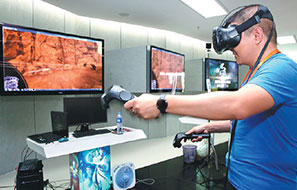
Military science institutions and corporations — the backbone of defense technologies — are spearheading many of China's cutting-edge science projects, ranging from manned-space missions to navigation satellite systems to supercomputers.
At the same time, civilian companies and institutions are becoming more innovative, resourceful and adaptive to market change.
Integrating military and civilian technologies will lead to more innovations and applications that can benefit both the military and society, said Lieutenant General Xin Yi, the deputy director of the Science and Technology Commission (STC) of the Central Military Commission.
"Integration of military and civilian technologies is crucial in improving national defense and building a modern military," Xin said in a press conference. "It is also a powerful engine for facilitating scientific innovations and social economic development."
The top military science authority and the Ministry of Science and Technology issued a plan for integrating military and civilian technologies for the next three years on Wednesday.
It included seven major missions, such as strengthening top-level design and overall planning; improving innovation capabilities and facilitating resource sharing between military and civilian institutions.
It will also enhance commercialization of military and civilian technologies; build new labs, platforms and pilot zones; train more innovative talents and optimize supporting policies.
"The plan is an important part of the nation's innovation development," said Huang Wei, the vice minister of the Ministry of Science and Technology. "It lays down the foundation and points the direction for integrating military and civilian technologies."
The plan will have great significance in building a rich nation and a strong military, he added.
Li Yandong, the deputy director of scientific strategy under the SCT, said this is the first time the SCT, which was founded in January 2016, issued a top-level strategic development plan.
"It is an instructive guideline to help military researchers take full use of market economy and government incentives, thus becoming a new supporting pillar for military construction and national defense," he said.
Zhang Xiaoyuan, the director of the ministry's resource and management department, said that by 2030, there will be more projects in deep sea and deep space exploration, information networks, quantum communication and other fields that military and civilian technologies overlap.
More labs, experiments and major scientific equipment also will be shared between the military and civilian research entities, he added.
Contact the writer at Zhangzhihao@chinadaily.com.cn