Human-machine future seen in blink of an eye
 |
|
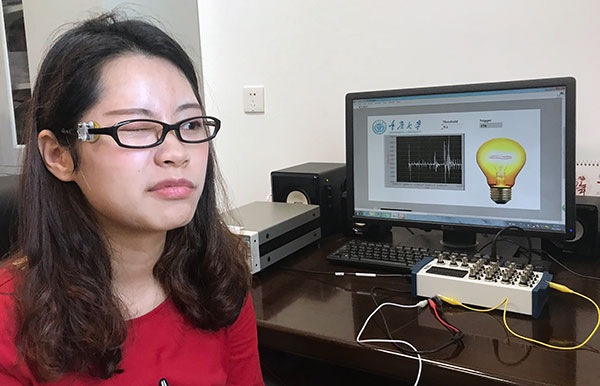
A test subject controls a virtual light bulb by blinking while wearing a pair of special eyeglasses with a new kind of microsensor.[Fu Xiaozhu/For China Daily] |
Tiny sensor offers new control over everyday life
A team of Chinese scientists recently invented a micromotion sensor that allows people to control devices and type text by blinking their eyes, according to a paper published in an international science journal.
The sensor is fixed to special eyeglasses and applied through two real-time human-machine interfacesa smart home control system and a wireless hands-free typing system.
It makes direct contact with the wearer's skin around the eyes and responds to changes in pressure when the wearer blinks intentionally to trigger a computer response.
"It is like a third hand," said Hu Chenguo, of Chongqing University's Department of Applied Physics, who led the research.
She said the sensor can help people control devices when both hands are occupied, or help people with disabilities to communicate and perform daily tasks.
Human-machine interfaces, or HMIs, involve communication between a person and an external device. But the skin-sensing interfaces based on bio signals have been developing slowly, owing to the low signal-to-noise ratio and poor stability, Hu said.
In the new study, Hu and colleagues designed a sensor based on what's called a triboelectric nanogenerator-or TENG-to detect the motion of the skin around the corners of eyes, which she said "has never been considered as a good trigger signal source".
"When the TENG sensor is attached to the inside of the glasses' frame, the minuscule muscle movement of a closing eye momentarily pushes the sensor's layers together, generating an electrical signal that can be reliably measured," the study said. It was published last week in the US journal Science Advances.
"It is supersensitive, stable, easy and cheap," said Pu Xianjie, the lead author of the report. "We are now applying for a patent in China and overseas. In the near future, we expect to see it on the market."
The sensor can initiate tasks such as turning a light on or off. When the glasses are connected to a computer screen, the wearer can blink as a cursor passes over different keys, typing out words.
"This TENG-based micromotion sensor is distinct and unique in its fundamental mechanism, which provides a novel design concept for intelligent sensor techniques and shows great potential for application in HMIs," Hu said.
"For our next step, we would like to ... explore the great potential of TENG sensors in intelligent robots."