Instrument makers dance to a traditional tune
 |
|
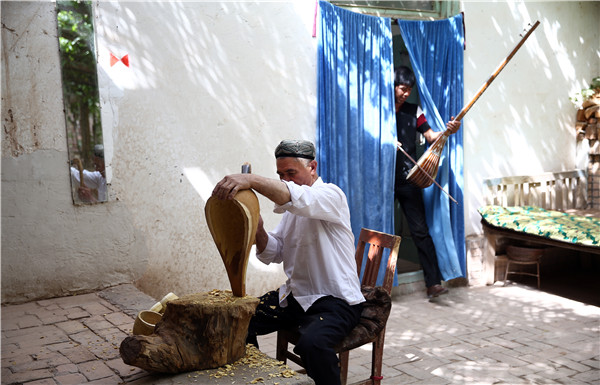
Rehman Abdula carves a dutar in Tuowankewuk sake village, Xinjiang Uygur autonomous region, as his son Mamutjon carries a finished instrument.[Photo by ZOU HONG/CHINA DAILY]] |
"He only appreciated the external beauty of my rawap but he cannot play it to release its true power, which is to charm people with the sounds it makes," said the craftsman, who is still waiting for the special person, someone who is just right for the rawap.
Rehman is determined to pass on the family tradition. In fact, he regards it as his duty. His eldest son lives in Urumqi, the regional capital, where he runs a shop that sells the family's work, but Rehman three other sons are instrument makers in Tuowankewukusake.
Rehman has high hopes for his youngest son Mamutjon, because the 27-year-old craftsman exhibits all the passion he had when he was young. "He is a quiet man, too," Rehman said.
Memutjon made his first instrument on his own when he was just 22. He uses social media to advertise his work, and now earns about 10,000 yuan a month from his labors.
"Unlike me, my father is very confident and never hesitates to use force when carving the instrument from the wood," he said, as he watched Rehman making a dutar. "The instruments even sound louder when he makes them."
Adaptation
To further improve the quality of traditional Uygur instruments, Memutjon has studied the structures of guitars and violins. "The ghijek plays like a violin and also sounds like one, so I think understanding the violin will help me make it sound better," he said.
In fact, the current version of the ghijek is actually an adaptation based on the study of violins. The new version was introduced in the 1950s.
The changes were made by Duan Qiang, a composer, and Samat Abdula, a violinist in a People's Liberation Army art troupe based in southern Xinjiang.
According to Duan, 83, he and Samat realized that the old-style ghijek had a narrow range of tones, which meant its use was limited, even within Uygur musical settings.
In response, the then-19 year old and his partner upgraded the instrument using a number of features of the violin as their model, and introduced the new version to Xinjiang.
It is capable of carrying the melodic line in harmony with other Uygur instruments across a wide range of music.
Last year, Duan invited four instrument makers from Jiayi village in southern Xinjiang's Aksu prefecture to his workshop in Urumqi. He taught them how to draw plans for different instruments using detailed measurements.
Jiayi is also famous for instruments. About 105 of the 208 families in the village make a living from their craftsmanship. Now, Duan hopes they will try to standardize production of traditional instruments by following the drawings he has made.
The new approach may work for younger craftsmen, but Rehman has no plans to adjust his style of working. His eyes, hands and heart are all he needs to make the perfect instrument.