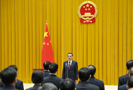
Senior judges return to the bench
More court presidents and chief judges are picking up their gavels again in a move to improve the quality of case hearings, China's top court said on Monday.
In the past, their roles have largely focused on court management or administrative affairs, attending meetings or conducting research, "but they have been asked to go back to the courtrooms to hear cases as part of judicial reform", said Xu Jiaxin, director of the Political Department at the Supreme People's Court.
Their return, initiated by a reform put forward by the central leadership in 2013, requires senior judges to play a bigger role in improving efficiency and alleviating the pressure brought on by the rapidly increasing number of disputes, he said.
Courts in Beijing, Shanghai and Guangdong province have moved ahead of other regions since the reform was launched. Last year, for example, court presidents and chief judges in the capital handled 138,000 cases, up 52 percent year-on-year, according to the top court.
To expand the reform, the highest judicial chamber issued a guideline in April, clarifying how many cases a president or chief judge should hear annually, and outlining some of the disputes they should handle.
For instance, the number of cases handled by a president in an intermediate people's court should reach 5 percent of the average amount handled by other judges in the court, while senior judges with administrative titles should first hear cases that are complicated, unique or that may stir up the public, it said.
"We hope more young judges can learn from presidents and chief judges in case hearings, upholding justice by improving the quality of trials," Xu added.
Chen Qi, president of Beijing Miyun District People's Court, has been regularly hearing cases in court.
"I not only read judicial documents and make verdicts. I attend all legal procedures of a case as I did before," she said, adding that what she does is also disclosed in the court and supervised by other judges.
But Xu said the reform does not mean presidents and chief judges can ignore administrative affairs. "It's to push them to balance their work," he added.
In addition, the top court is also ready to establish commissions at provincial level to supervise whether judges have made mistakes in applying laws or legal procedures, in a bid to improve the quality of case hearings.
caoyin@chinadaily.com.cn

- Chinese scientists set global record with artificial sun
- Tourism begins to make a mark on the mountain
- University issues China's first letter of acceptance using AR
- The world's first pigs cloned by robotic instrument born in Tianjin
- Mainland lowers threshold for Taiwan's college applicants