Scientists voice expectations of China's new space telescope
 |
|
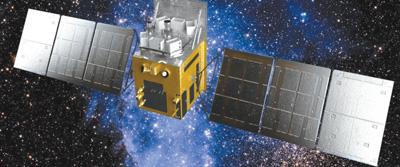
An artist's impression of the space telescope, Hard X-ray Modulation Telescope. [Photo provided by State Administration of Science, Technology and Industry for National Defence] |
BEIJING -- China on Thursday launched a space telescope, the Hard X-ray Modulation Telescope (HXMT), or Insight, to observe black holes, neutron stars, gamma ray bursts and other celestial phenomena.
The result of the wisdom and painstaking efforts of several generations of Chinese scientists, the telescope is expected to push forward the development of space astronomy in China. Scientists from both home and abroad have high expectations of it.
"Before its launch, we could only use second-hand observation data from foreign satellites. It was very hard for Chinese astronomers to make important findings without our own instruments," said Xiong Shaolin, a scientist at the Institute of High Energy Physics of the Chinese Academy of Sciences (CAS).
"The only way to make original achievements is to construct our own observation instruments," Xiong said.
"Now Chinese scientists have created this space telescope with its many unique advantages, and it's quite possible we will discover new, strange and unexpected phenomena in universe."
Gou Lijun, a researcher at the National Astronomical Observatories of the CAS, said China missed opportunities for many discoveries as approval of Insight and its development and launch was postponed many times.
However, it is the first step for China in the field of X-ray astronomy and learning how to develop and operate a space telescope, Gou said.
"Although many advanced X-ray astronomical satellites from other countries are already in orbit, HXMT could still make important discoveries," said Gou. "The universe is full of surprises."
Zhang Shuangnan, lead scientist of HXMT, said the launch puts China in the vanguard of international X-ray astronomy with a dozen other X-ray satellites in orbit. This is both an opportunity and a challenge for China. HXMT will both compete and collaborate with other X-ray satellites.
The research and development of China's first X-ray astronomical satellite laid a good foundation for the development of future X-ray astronomical instruments, Zhang said.
Li Tipei, the CAS academician who first proposed the satellite in the early 1990s, said Chinese scientists could have made many great scientific discoveries if it had been launched within 10 years of first being mooted. Even so, he is confident the satellite can make new findings.
"Our satellite has advantages in detecting transient phenomena and X-ray explosions of celestial bodies. And its functions have expanded, as its developers added more detectors so it can cover a broader range of energy," Li said.
Gu Yidong, a CAS academician, said China still lags behind advanced levels in space science. "We should have a sense of urgency. We will make efforts to upgrade China's space science to advanced levels within two decades."