In landmark experiment, scientists beam back 'entangled' photons from space
 |
|
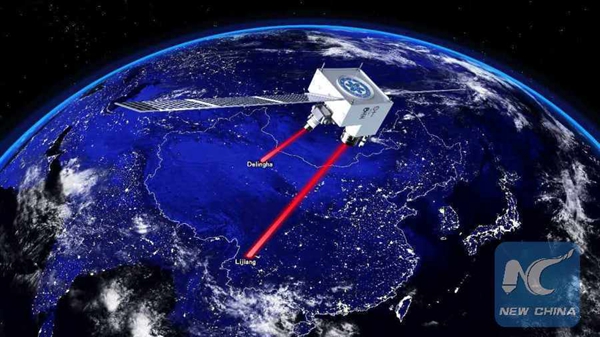
The photo shows artist's rendering of satellite Micius. [Photo provided by Pan Jianwei to Xinhua] |
WASHINGTON - Chinese scientists on Thursday reported a successful transmission of "entangled" photon pairs from space to ground stations separated by 1,200 km, a major technical breakthrough towards quantum communication over great distances.
The study, published as a cover story by the US journal Science, distributed such "entangled" photons, or light particles, from a satellite 500 km above the Earth's surface, known as Micius, which was launched last year and equipped with specialized quantum tools.
It's another effort to prove that a physical phenomenon once described by Albert Einstein as "spooky" exists at a large distance, and eventually on a global scale.
"This work lays a reliable technical foundation for large-scale quantum networking and quantum communication experimental research, as well as experimental testing of basic principles of physics, such as general theory of relativity and quantum gravity, in outer space in the future," Pan Jianwei, chief scientist for the quantum satellite project, told Xinhua.
Factbox: What is quantum communication?
WORLD RECORD
Quantum entanglement, which Einstein referred to as "a spooky action at a distance," is a curious phenomenon in which particles are "linked" together in such a way that they affect one another regardless of distance. It is of great significance for secure communications, quantum computation and simulation, and enhanced metrology.
Yet, efforts to entangle quantum particles, such as photons, have been limited to about 100 km, mostly because the entanglement is lost as they are transmitted along optical fibers, or through open space on land, Pan said.
One way to overcome this issue is to break the line of transmission into smaller segments and use so-called quantum repeaters to repeatedly swap, purify and store quantum information along the optical fiber, while another approach is to make use of satellite-based technologies.
In the new study, Pan, a professor at the University of Science and Technology of China, and his colleagues used the Chinese satellite Micius to demonstrate the latter feat.
The Micius satellite was used to communicate with two ground stations 1,203 km apart, located in Delingha in Northwest China's Qinghai province and Lijiang in Yunnan province in southwest China, separately. The distance between the orbiting satellite and the two ground stations varies from 500 to 2,000 km.
By combining so-called narrow-beam divergence with a high-bandwidth and high-precision acquiring, pointing, and tracking technique to optimize link efficiency, the team established entanglement between two single photons, separated at a distance of over 1,200 km apart, for the first time, Pan said.
In addition, compared with previous methods using the best performance and most common commercial telecommunication fibers, the effective link efficiency of the satellite-based approach is 12 and 17 orders of magnitude higher respectively.
- Space telescope launched
- China's quantum satellite establishes photon entanglement over 1,200 km
- Nation launches first space-based X-ray telescope
- China launches space telescope to search for black holes, pulsars
- China to open space station to scientists worldwide
- Space race or cosmic cooperation? China strongly calls for the latter