Subsidies keep ancient music safe and sound
 |
|
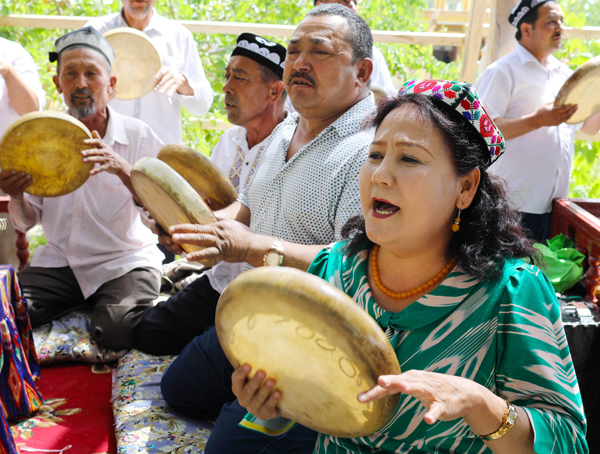
Uygur musicians in Awati county perform a muqam, a form of music dating back as early as the Tang Dynasty (618-907). Photo by Zhu Xingxin |
While many young people in Aksu are finding jobs in textile factories, some are earning a living by helping to keep alive the traditional sound of the Xinjiang Uygur autonomous region.
Uygur muqam is a unique type of music developed during the Tang Dynasty (618-907) that has 12 sets of melodic formulas and can be performed by soloists or ensembles.
Adil Abula has studied the art for a decade and regularly performs at a tourism resort in Aksu's Awati county.
"I've been addicted to the music since I heard my uncle sing it when I was a child, but I never thought I could be paid by performing it," said the 30-year-old musician.
As part of its heritage protection efforts, the county government pays musicians a subsidy of 300 to 1,000 yuan ($45 to $150) a month - depending on their skill level - to encourage them to share the traditional art.
"In other words, we can earn additional money by giving muqam performances at tourist spots, like museums and cultural theme parks, as well as in other areas of China," Abula said.
Abudulkadeer Mussar, 74, who taught Adil, welcomed the authorities' efforts to protect this ancient art form and said he has agreed to increase his appearances at visitor attractions.
"It's a good way not only to stimulate employment, but also to preserve the Uygur people's music treasure," he said.
For many years, muqam was in danger of disappearing because it is difficult to perform, he added, "but four years ago, when the central leadership highlighted the heritage of traditional arts, it was given a new lease of life."
Today, Mussar, along with more than 70 other top musicians from Awati, regularly tour the region as well as other provinces to give performances and spread the sound of Xinjiang.
In the past, he said, young people used to see the life of a muqam musician as hard, but thanks to the financial support and other cultural preservation efforts, that is no longer the case.
"During the farming seasons, I grow cotton," Abula said, "In my spare time, I can get an extra income by singing my favorite muqam."