Putonghua push puts local dialect in spotlight
 |
|
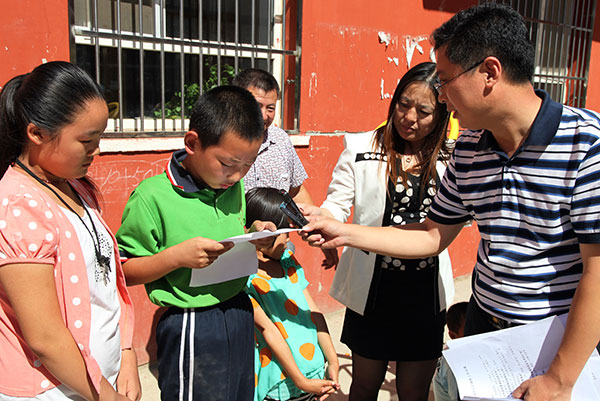
An expert from the State Language Commission collects samples of the dialect in Luanping county, Hebei province.[Photo by Huo Tengda for China Daily] |
The government's decision to raise the number of people who speak the country's official, standardized language has drawn attention to a small county in North China, as Zhang Yu reports from Chengde, Hebei province.
About 1 billion people in China speak Putonghua, the national, standardized form of Mandarin, as their mother tongue. Although those people account for more than 70 percent of the population, the government has decided that the number will be raised to 80 percent by 2020.
A blueprint released last month detailed the changes, including the requirement that some professionals, such as teachers, will have to pass oral tests in Putonghua before they can be appointed to a post.
While the plan has attracted attention nationwide, it has also focused the spotlight on Luanping, a small, mountainous county in Hebei province, where the local dialect shares so many similarities with China's official language that the residents often tell stories that express their pride at living in the "home of Putonghua".
Probably the most famous tale concerns identical twins whose parents divorced, resulting in the boys being separated and sent to live in different parts of the country.
The older boy lived with his father in Qingdao, a city in Shandong province, about 650 kilometers southeast of Beijing. The younger sibling lived with his mother in Luanping, about 150 km northeast of the capital.
The boys looked so similar that even their parents were unable to tell them apart. However, by the time they were approaching adulthood, they were easily distinguishable-not by their appearance, though, but because they spoke different dialects.
The older brother spoke the Shangdong dialect, which is almost unintelligible to outsiders, and learned Putonghua at school. The younger brother spoke the Luanping dialect, which sounds almost exactly like Putonghua.
Although the boys still looked identical, they could be distinguished from the way they spoke.
Hao Zongju, a Luanping native, often tells that story when she attempts to convince friends who have never visited the county that her native dialect is the bedrock of the modern official language.
"Our linguistic environment can assimilate everybody who lives in the county for a long time," Hao said.
She added that many Luanping natives exploit their linguistic advantage to gain work as receptionists, broadcasters, attendants and tour guides.