Ivory carvers want craft preserved
 |
|
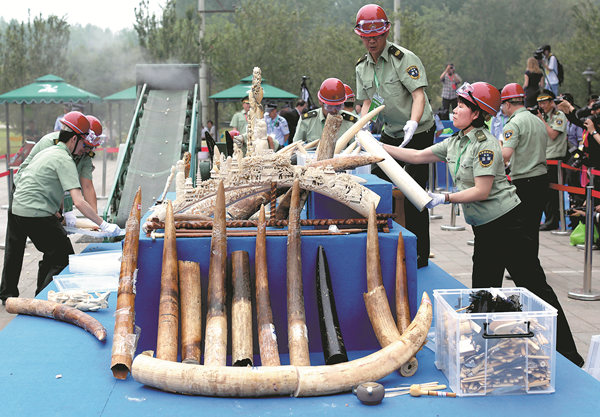
After years of strictly regulating trade in ivory and destroying illegal items, as police prepare to do in this photo from 2015, China is banning any illegally sourced ivory, sounding a death knell for scores of ivory workshops and retailers. WANG JING / FOR CHINA DAILY |
The trade in illegally sourced material will be banned by the end of the year, resulting in job losses and the death of ancient expertise, as Yang Wanli reports.
In recent weeks, Weng Zhanxuan has faced a dilemma as he struggled to make a decision between his future and his family's traditional trade; making sets of balls in which several rotatable layers are carved from a single piece of ivory.
The 24-year-old artisan's family has been making the balls for about 200 years, and he is the sixth generation to follow in his forefathers' footsteps. The layered balls and ivory boats made in Guangzhou, his hometown in Guangdong province, represent the pinnacle of the Southern, or Canton, style of ivory carving in which the motifs are intricate, rich in detail and have elegant engravings as the focal points.
Both his father and his grandfather are revered as national arts and crafts masters, and although Weng only took up the art five years ago, he can carve a ball 11 centimeters in diameter and containing 33 layers — an achievement that usually takes 10 years of practice.
However, these skills no longer provide carvers with a high standard of living as a result of the significant reduction in the ivory trade since 1981, when China signed the Convention on the International Trade in Endangered Species of Wild Fauna and Flora. In 1989, the convention prohibited ivory sales globally to protect elephants.
Weng and his father may soon lose their jobs at the Guangzhou Daxin Ivory Carving Factory because three months ago, the State Forestry Administration, which manages the ivory trade, announced that all commercial processing and trading will be banned at the end of the year.
In the 1970s, Weng's father earned 80 yuan ($11.60) a month, almost three times the average income of urban workers at the time.
The father and son's combined monthly wage is no more than 6,000 yuan, lower than the average 7,178 yuan paid to new employees in Guangzhou last year, according to a report by Zhilian Recruitment, one of China's biggest recruitment websites.
As a graduate in mechanical and electrical engineering at a local vocational school, Weng Zhanxuan said most of his classmates now work for vehicle companies and earn 10,000 yuan ($1,450) a month, five times his salary.
"My wage is the lowest in my class. What comforts me is that I did a good job of continuing my family's traditions," he said.
However, his story is likely to have an unhappy ending, because both he and his father may soon lose their jobs at the Guangzhou Daxin Ivory Carving Factory.
Three months ago, the State Forestry Administration, which manages the ivory trade, announced that all commercial ivory processing and trading will be banned at the end of the year.
Last year, China had 34 designated ivory-processing enterprises and 143 designated retail outlets. By the end of March, the administration had closed 12 processors and 55 retailers. The rest will be closed by the end of December.
Three of the Daxin factory's retail outlets have closed, and the workshop where Weng and his father work with 33 other artisans is slated for closure.
"I'm very proud of my family's craftwork and will continue with this career, no matter whether it makes me rich or poor," Weng said. "But the ban on trading means we can no longer live on our skills."
Promotions for animal protection can be seen everywhere in Guangzhou's subway stations and bus stops. Celebrities with stern faces hold signs reading, "Say no to ivory products".
To Weng, the promotion is flawed. "We work with legal ivory, not tusks from illegally slaughtered animals. Sure, those thousands of elephants should be protected, but what about all the ivory carvers? Doesn't anyone care about the extinction of our art?" he asked.