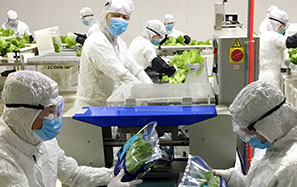
Sustainable food production looking up
In addition to sanitation, scientists also take temperature, humidity, air circulation, light, carbon dioxide, nutrients and other elements into account to create the "perfect environment" for growth.
A tightly controlled environment not only maximizes growth potential, but also allows scientists to create food that suits specific needs, Zheng said.
For example, scientists can lower the amount of potassium from lettuce for patients with kidney problems or increase zinc in cabbage for children by altering the nutrient solution and growing conditions.
"This is the fundamental difference between a plant factory and conventional farm," he said. "We simply have extensive control over how and when our plants can grow, and let nature run its course in the most ideal conditions."
The requirements for plant growth fall into two broad categories: photosynthesis and soil nutrients.
The sun accounts for 90 percent of all botanic bioenergy through photosynthesis — a process in which plants combine carbon dioxide and water and turn them into carbohydrates and oxygen. Sunlight is a bundle of different wavelengths of light across a wide spectrum from ultraviolet to infrared.
Plants are "picky eaters that favor blue and red lights", Li said. "If we can figure out what ratio and combination of lights are best suited for each plant's growth, then we can change or create LED lights that shine at that specific intensity and spectrum, saving lots of energy in the process," he added.
While blue and red lights are the "meat and potatoes" of a plant's growth, scientists notice other spectrums of light also play a subtle role in maximizing growth and quality.
For example, scientists discovered that adding some green light to the red-blue recipe could help some vegetables grow, while too much green light puts plants into hibernation, although this is helpful for the plant's nutrient build up.
"Mimicking sunlight using LED is very energy intensive," Li said. "At the end of the day, whoever has the most energy-efficient and productive light recipe wins."
While plant growth mostly relies on light, water and carbon dioxide, it still needs some trace elements from soil or fertilizers to be healthy. In the case of plant factories, hydroponic nutrient solutions infused with 17 essential elements ranging from nitrogen to calcium have replaced the tilted soil.
"The content of the nutrient solution is also tailored to suit the plant's specific needs," said Pei Kequan, a research director at the factory. Unlike the trace elements from fertilizers, which are locked in big compound molecules, "the nutrients in the solution are broken into small molecules, meaning the plant can absorb them easier and grow faster while keeping its nutrient value and taste".
It takes about 20 days for a sapling to reach maturity in the lab, but 40 to 60 days in a conventional farm. This means scientists can reap more than a dozen harvests of produce each year, compared with one to two harvests from a conventional farms, depending on the weather conditions, he said.
Moreover, scientists at the facility have built the infrastructure to monitor the elements in the solution. Once an element is depleted, scientist can add the missing nutrient and reuse the solution without needing to make a new batch, thus reducing the cost.
"We go to great length to study and cater to our plant's most fundamental needs, making sure they could grow under the best conditions," Pei said. "In a way, the plants are the kings, and we are all its servants."
It's high time we find a sustainable and green way to protect our food security."
Li Shaohua, director of San'an Sino-Science's Photobiology Industry Institute