Sticky rice balls make tradition 'stickier' for young Chinese
SHANGHAI - Weeks before the Chinese Qingming Festival, which falls on Tuesday, many young people in Shanghai waited in line for hours to have a bite of a century-old snack.
Qingtuan, a sweet green rice ball, is a must-have offering for the ancestral rituals of Qingming Festival in the Yangtze River region.
Thanks to social media and e-commerce, the traditional snack, almost gone among young Chinese who work far from home, is gaining popularity.
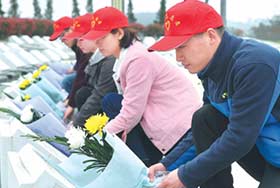
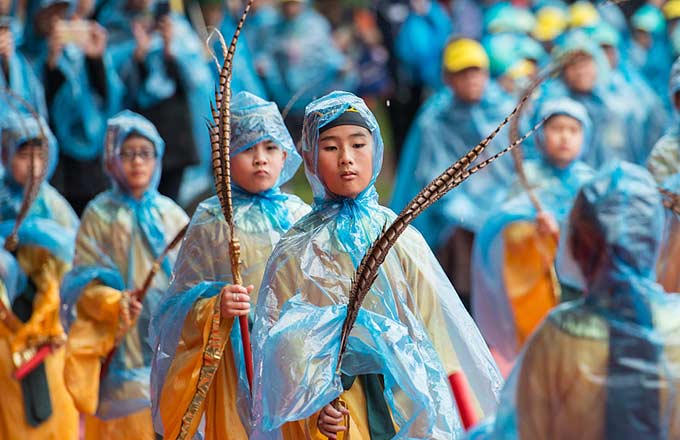
Qingming Festival, or Tomb-sweeping Day, falls on the 108th day after the winter solstice. Chinese traditionally honor their ancestors by sweeping their tombs on this day.
Instead of making Qingtuan by hand like their mothers or grandmas, young people buy them with a smartphone app or simply queue up at Xinghualou, a famous bakery in Shanghai, which sells the Qingtuan stuffed with dried meat floss and yolk.
"I saw my friend posting pictures of tempting Qingtuan on WeChat. It is a must-try that's definitely worth the long wait," said 28-year-old Yu Sheng, in the line.
Qingtuan at Xinghualou are sold at 50 yuan a box (about $7), with six balls in each.
"One can only purchase four boxes at most," reads a notice in the store.
Last year when Xinghualou decided to reintroduce the snack with a new taste, people had to wait for up to six hours to get some. This year, it takes at least two to three hours on weekdays.
"As many as 300,000 Qingtuan balls with the new stuffing can be sold in our three main stores in a single day," said Zhi Jing with Xinghualou. "Our sales of Qingtuan have more than doubled in March compared with last year's 10 million yuan."
Young foodies also shared stories with buying or tasting Qingtuan on social media.
"I waited for two hours in the rain," said netizen Ayuesansan. Scalpers have also appeared, charging at least ten yuan for queuing up.
A box of Qingtuan is sold for as much as 70 to 100 yuan on Alibaba's online sales platform Taobao.com, with people in northern China attracted by this snack they had never heard before.
"I'm from north China, and I tried a Qingtuan for the first time today. It's very sweet and yummy!" said BigFayFay on Weibo, a Twitter-like service.
Qingtuan are now also sold for the first time at convenience stores, popular with young people.
"We are surprised to find their overwhelming popularity," said staff with Laiyifen, a snack chain that has over 2,000 stores across China.
The tradition of eating Qingtuan at Qingming Festival can be traced back to the Zhou Dynasty (1046 BC-256 BC) over 2,000 years ago, according to Zou Kunxing, who has been making the traditional cuisine for decades in Suzhou city in eastern China's Jiangsu Province.
"A legend goes that the ritual to eat Qingtuan is related to Hanshi Festival or Cold Food Day, usually one to two days before the Qingming Festival. Food such as Qingtuan are prepared for the day when all families don't start a fire and stop cooking, in memory of Jiezitui, a virtuous official who died in a fire," said Zou.
"To make a Qingtuan, first, you need to get wormwood grass that only grows in April and then smash it into juice. Then, you mix the juice with glutinous rice, and make it into a rice ball. After, you fill the rice ball with red beans and a nip of lard oil as the stuffing. Finally, you steam it," Zou said. "We make stuffing with sesame too, or minced vegetable and meat in regions such as Zhejiang."
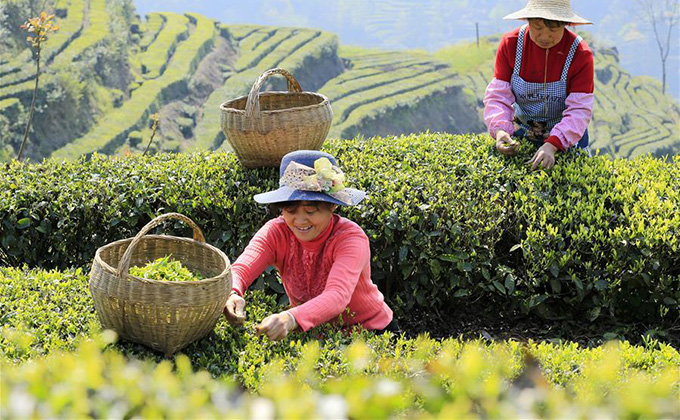
In Jingning She autonomous county in Lishui city, eastern China's Zhejiang province, Lan Xiangmei, 62, is making Qingtuan at home.
"I learned how to make Qingtuan from my mother when I was a child, and now I teach my daughter. Every family in the county makes Qingtuan for Qingming," she said. "Compared with new flavors, I prefer the traditional ones with red beans, sesame, or dried bamboo shoots with minced meat, which taste the same as what I had in my childhood."
In 2008, the Chinese government made Qingming Festival a public holiday to preserve the tradition.
The Qingming Festival is among the 24 solar terms --important astronomical points on the Chinses calender -- listed by the UN Educational, Scientific, and Cultural Organization as an Intangible Cultural Heritage of Humanity in November last year.
"Chinese people are now paying more attention to traditional festivals, and food we eat for the festivals are coming back and gaining popularity," said Pan Renqing, a restaurant manager in Hangzhou.
"Making old snacks with new stuffing can help attract more young people, but it is more important to pass down and reinvigorate the traditional ritual," said Zhou Sannan, who has been making Qingtuan in Suzhou for over two decades.





- 4 killed, 1 injured after falling in sewage well in Central China
- Man caught in Southwest China for cross-border drug trafficking
- Overseas experts expect China's new economic zone to set example for developing economies
- Sino-US friendship has strong roots in Muscatine, Iowa
- China to increase mandarin speaking rate to 80 pct