Relocating endangered porpoises
 |
|
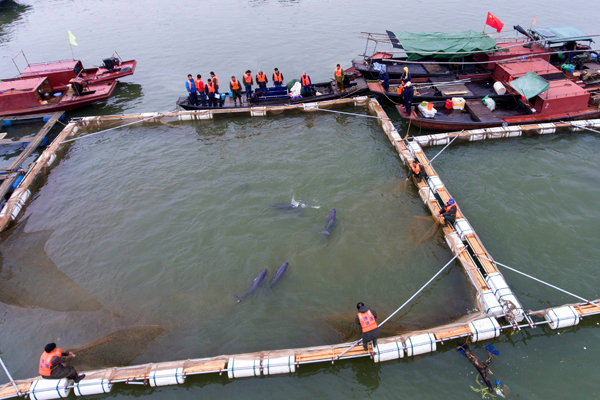
The four finless porpoises were kept in a temporary enclosure in Poyang Lake near Duchang, Jiangxi province, on March 25, before being relocated to Hubei province. [Photo by Fu Jianbin/China Daily] |
Four finless porpoises from Poyang Lake in East China's Jiangxi province were relocated on Monday as part of a program to conserve the critically endangered species.
The mammals, two males and two females, were transferred to the Hewangmiao Nature Reserve in Hubei province along traffic-free sections of the Yangtze River, according to sources at the Chinese Academy of Sciences' Institute of Hydrobiology.
The reserve has a vast body of water, which is clean and rich in aquatic biodiversity due to limitations on fishing, the sources said.
The animals' relocation is part of a project launched this year by the Ministry of Agriculture, the Chinese Academy of Sciences and three provincial governments to relocate 22 of the porpoises, which are facing extinction.
"Our plan is to move them to areas that are free from human activity, so they can flourish," said Wang Ding, a porpoise expert.
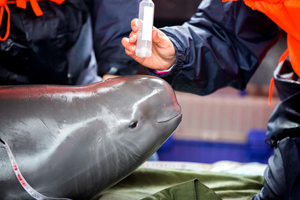
Known for their expressive faces, finless porpoises are only found in the Yangtze River and two lakes linked to the busy waterway. Due to overfishing, river traffic and pollution, there are only around 1,000 of them left in the wild.
China first started relocating porpoises in 1992 after concerns were raised about the species' survival, due to the population plummeting by 13.7 percent every year, on average, despite preservation measures.
"At first, the relocation idea was floated to protect the Yangtze River dolphin, but they were functionally extinct before we were able to act," said Wang Kexiong, a researcher with the Chinese Academy of Sciences.
To protect the finless porpoise, China has established three nature reserves in Hubei, Hunan and Anhui provinces, and there are also plans for more to be set up in the middle and lower reaches of the Yangtze River.
"It has been an effective measure. We have recorded three to five births each year. The Tian'ezhou reserve in Anhui already has more than 70 porpoises," Wang said.
The Yangtze, China's longest waterway, is known for its aquatic biodiversity. A decade ago, it was the only river in the world that had two kinds of aquatic mammal living in it at the same time-the finless porpoise and the eponymous dolphin. However, a 2006 survey found no dolphins in the river, which suggests they are functionally extinct-meaning the population is too small for the species to recover.