Going sleepless in Shanghai
People in Shanghai and Guangzhou have the most trouble sleeping, according to an online survey released on Thursday.
Changsha, Beijing and Shenzhen rounded off the top five places for sleepless Chinese.
The survey of more than 8,500 respondents in 362 Chinese cities was conducted between Feb 25 and March 12 by tech giant Tencent.
It was designed to raise public awareness of insomnia and to mark the World Sleep Day, which falls on March 21.
Nearly 80 percent of respondents said they have suffered sleep problems. Shanghai reported the highest rates of insomnia, at nearly 88 percent. Guangzhou, capital of Guangdong province, and Chengsha, capital of Hunan province, followed with 79.4 percent and 79.2 percent.
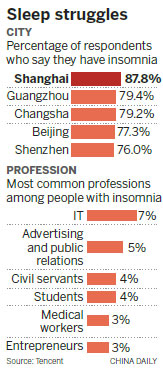
In terms of the respondents' occupations, those that are relatively more susceptible to insomnia include people in information technology, advertising and public relations as well as civil servants and those in healthcare and education.
Wang Yuping, head of the internal neurology department of Xuanwu Hospital in Beijing, said that pressure and anxiety is the major cause of sleep problems.
Thereafter, people living a slow-paced life in small and laid-back cities tend to have better sleep quality, he said.
Wang urged Chinese to pay more attention to their own quality of sleep and to seek timely medical intervention in case of insomnia.
According to him, apart from low energy, and poor attention and memory, long-term insomnia might increase the risks of other diseases such as obesity, hypertension, diabetes, depression and cancer.
However, the survey found that more than 57 percent of the respondents were not fully aware of that.
Only 4.5 percent of the respondents said they would see a doctor for insomnia. Of the respondents who never had insomnia, only 35 percent deemed it a medical condition.
That figure, by contrast, stood at 83 percent among those who have suffered insomnia.
On the clinical side, females are more likely to seek treatment than males, and the majority of patients are middle-aged or elderly, Wang said.
He suggested people also pay attention to occasional bouts of insomnia and seek professional treatment. "Otherwise it's very likely to develop into a chronic condition."