What villagers' rise from poverty looks like
Looking ahead
Two major factors that throw families back into poverty are medical fees resulting from major illnesses and the cost of higher education, according local officials and residents.
The family of Xiao Fumin, 63, a local farmer, suffered a huge financial blow when it shouldered the daunting cost of treatment for his daughter's toxemia.
"She needs dialysis twice a week, and the medical insurance covers 10,000 yuan each year," Xiao said.
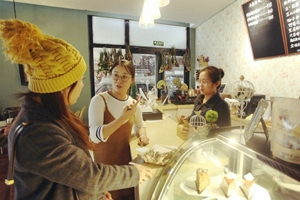
Now the burden is being eased as his family runs a restaurant that is supported by his village.
Bashang village, which once hosted the Red Army, now hosts tourists and groups of officials from all parts of the country for training and studies. The visitors are sometimes introduced to households like Xiao's.
Huang Chengzhong, Party chief of Shenshan village, said that a lasting financial capability in tackling poverty partly stems from the increasing strength of the village's collective economy, which means businesses run by cooperatives of residents, Huang said.
The village-run businesses include tourism, as well as the planting and processing of tea, bamboo and yellow peaches.
"As long as the village-run collective economy is strong enough, those financially challenged households will be helped by the village," Huang said.
Another problem is the widespread ignorance of the disparity between rural and urban areas, particularly the gap in the access to skills and technologies.
When tourists flock into inns and restaurants located in Zuo Xiangyun's village, many express amazement at the great changes happening there.
Some say they believe that the local villagers' rise to well-off status is easy to see because visitors come to honor the revolution's hometown, which brings a steady flow of cash.
However, recalling his experience of learning the technique of getting the laser machine and software to run for inscribing bamboo penholders, Zuo said achieving success has its frustrations.
Some of those from whom he sought help didn't want to share their techniques, while some others were not quite proficient enough to get the equipment running as expected.
"So I needed five or six teachers before I fully mastered the technique," Zuo said.
Another awkward fact is that although Zuo got broadband internet service installed in his house several years ago, he has not yet enjoyed Wi-Fi.
It was simply because no one informed him that he could replace the cable router with an updated one with wireless functions.
As a result, he uses GPRS, or 4G, signals to surf the Web and receive payments via WeChat, resulting in a monthly telecommunication cost of around 100 yuan.