Mutation of H7N9 poses 'no new threat'
The mutation of the H7N9 bird flu virus poses no new threat to humans, but sustained vigilance is needed for possible further mutations, both the World Health Organization and Chinese Center for Disease Control and Prevention said.
"The reported genetic changes in the H7N9 virus apply to poultry and there is no evidence that the changes in the virus affect the virus' ability to spread between humans," the WHO China Office said in a statement provided to China Daily on Tuesday.
"Currently, the risk of human-to-human transmission is low, as this virus does not appear to transmit easily from person to person," it said.
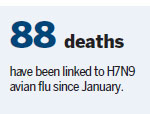
China has stepped up prevention of H7N9 avian flu transmission. It has been linked to at least 88 deaths since January. About 271 cases of human infection have been reported.
The H7N9 bird flu virus has mutated to a new strain in South China, which has proven more dangerous to poultry, but poses no new threat to humans, China CDC said in a statement posted on its website on Sunday.
The mutation was found in January in two people who had contracted H7N9 bird flu in Guangdong province, both having had exposure to live poultry. China CDC has confirmed the finding and reported the case to the WHO, it said.
The agricultural sector has also found the mutation in four poultry samples from Guangdong, China CDC said.
On the basis of a joint study with experts from the agricultural sector, China CDC has concluded that the mutation "does not make the virus more infectious to humans at the moment."
Chinese health and agricultural authorities will continue to study the mutated strain's source and its impact while intensifying monitoring to detect H7N9's further mutations, according to the statement on China CDC's website.
"Reported changes suggest that the virus continues to evolve as part of its natural progression. Influenza viruses continuously evolve and re-assort, so it is important to remain vigilant," the WHO said.
"WHO is working with international partners, including China, to coordinate the global health response, including risk assessment, the provision of updated information on the situation, and guidance for health authorities and technical health agencies on interim surveillance recommendations, laboratory testing of cases, infection control and clinical management," it said.
The Guangdong provincial government has banned exports of live poultry to other areas of China until March 31, unless the poultry has passed veterinary tests for the virus. Meanwhile, Guangdong also suspended imports of live poultry from provinces more seriously hit by H7N9 cases - such as Jiangsu, Zhejiang and Anhui - until the end of March, according to the provincial government.
(China Daily 02/22/2017 page5)