China schedules Chang'e-5 lunar probe launch
 |
|
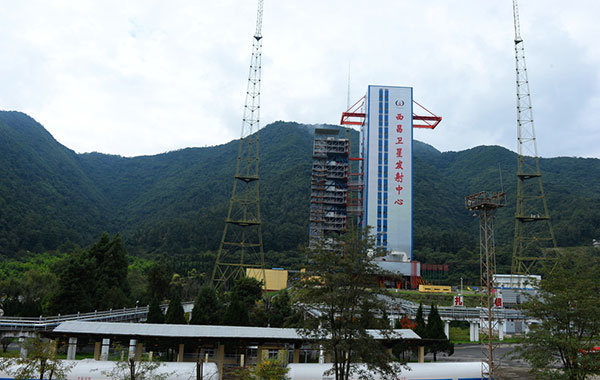
File photo shows a Long March 3C (CZ-3C) carrier rocket carrying a lunar orbiter for the Chang'e-5 lunar probe stands on the launch pad at the Xichang Satellite Launch Center in Xichang city, Southwest China's Sichuan province, October 23, 2014. [Photo/IC] |
BEIJING - China plans to launch the Chang'e-5 lunar probe at the end of November this year, from the Wenchang Space Launch Center in southern China's Hainan province, aboard the heavy-lift carrier rocket Long March-5.
The mission will be China's first automated moon surface sampling, first moon take-off, first unmanned docking in a lunar orbit about 380,000 km from earth, and first return flight in a speed close to second cosmic velocity, according to the China Aerospace Science and Technology Corporation (CASC).
"With a weight of 8.2 tonnes, the lunar probe is comprised of four parts: an orbiter, a returner, an ascender and a lander," said Ye Peijian, one of China's leading aerospace experts and a consultant to the program.
The lander will put moon samples in a vessel in the ascender after the moon landing. Then the ascender will take off from the moon to dock with the orbiter and the returner orbiting the moon, and transfer the samples to the returner.
The orbiter and returner then head back to the earth, separating from each other when they are several thousands kilometers from earth. Finally, the returner will reenter the earth.
The development of Chang'e-5 has entered the end of its flight model phase, and relevant work is proceeding smoothly, according to CASC.
China plans to fulfill three strategic steps with the launch of Chang'e-5, "orbiting, landing and returning."
The country also plans to launch the Chang'e-4 lunar probe around 2018 to achieve mankind's first soft landing on the far side of the moon, and to conduct an in situ and roving detection and relay communications at earth-moon L2 point, according to the China National Space Administration.
"The country plans to send robots to explore both lunar poles," said the administration's vice director Wu Yanhua late last year, adding that plans to send astronauts to the moon were also being discussed.