Noncore functions shifted to suburbs
 |
|
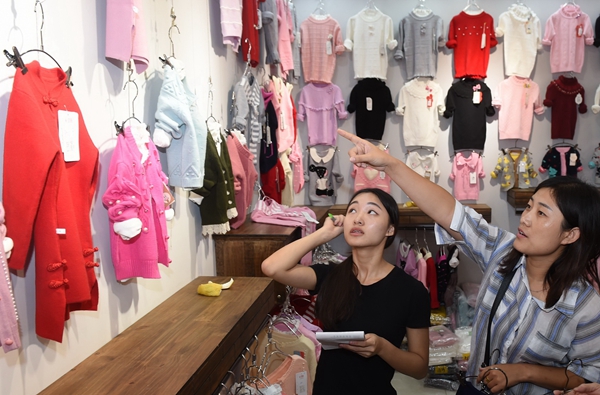
Customers visit a stall in Cangzhou, Hebei province, in September after some vendors transferred to the city from the Beijing Zoo clothes market.[FU XINCHUN/CHINA DAILY] |
Vendors moved to neighboring cities said new business is weak
Beijing planners will continue to unclutter the capital by shutting down or relocating businesses that do not serve a core function, according to the city's Government Work Report for 2017.
Among the key tasks is moving more traders from the sprawling Beijing Zoo markets as well as closing more than 500 low-end manufacturers and polluting companies, Acting Mayor Cai Qi told the annual session of the Beijing Municipal People's Congress, the city legislature, as he presented the report on Saturday.
Beijing has identified itself as a center for four core functions: politics, culture, international communication, and science and technological innovation.
"According to the Beijing-Tianjin-Hebei integrated development plan, the capital will take a big step to remove all noncore functions this year," Vice-Mayor Li Shixiang said at a news conference on Sunday.
The city government will release guidelines on how the newly empty land can be used, he said, adding: "It will initially be used to improve roads, and for new parking lots and community services. After that, it will be considered for its potential for economic growth, such as developing high-end industries. The basic principle is to use the land in a better way, avoiding low-end repetition."
Wholesale markets have played an important role in the city's development for decades, Li said, but they no longer fit with Beijing's development, while the valuable land they occupy "should be used for more urgent needs such as public services and high-technology research".
The Beijing Zoo clothes market began in the 1980s and over the years swelled to about 13,000 stalls covering more than 300,000 square meters. The market generated 20 billion yuan ($2.9 billion) in revenue in 2016, according to the Xicheng district government.
However, the market was blamed for causing severe traffic congestion and was considered unfit for the capital's downtown area.
Authorities announced in 2014 that it would be relocated, with traders moved to Shijiazhuang, Baoding and Cangzhou, all cities in neighboring Hebei province.
Lu Yan, director of the Beijing Municipal Development and Reform Commission, told China Daily that more than half of the market was relocated in 2016, with the rest to be moved this year.
One trader who still runs a stall near the zoo said the markets in Shijiazhuang and Baoding have done well, but that vendors who have transferred to Cangzhou have complained of weak business.
"I'm due to move out in 2017, but I'm now considering whether to keep working in the business or find something else to do," said the trader, who did not want to be identified.
Lu responded by saying that it will take time for the relocated markets to regain their popularity. "The Beijing Zoo market developed over 30 years. We need patience," he said.