Traffic gets heavier in third of cities; Jinan ranks worst
 |
|
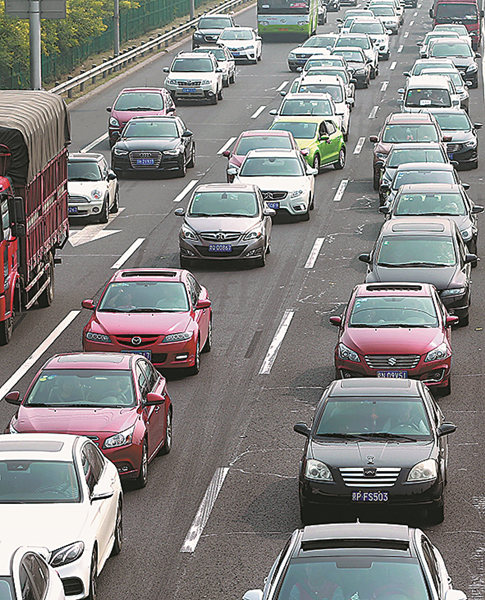
Traffic came to a virtual standstill on the Beijing highway heading toward Tibet on Oct 2, during the National Day holiday. |
One-third of 100 China's cities faced worsening traffic congestion in 2016, according to a survey by AutoNavi Software Co.
In many cases, more cars were to blame. In some cases, as with Jinan, capital of Shandong province, the most congested city, disruption caused by efforts to improve public transportation temporarily worsened things.
In the 32 cities where traffic worsened, it took 1.8 times as long to travel during rush hours — from 7 to 9 am and 5 to 7 pm — as it did during off-peak hours, the company said.
Aside from the 32 cities that got worse, traffic in 36 cities remained the same over the previous year, and another 32 cities improved, the report said.
Among China's larger cities, traffic got worse in Beijing and Shenzhen in 2016, while things improved in Shanghai and Guangzhou.
Beijing lost its 2015 position as the country's most congested city, and was replaced by Jinan, followed by Harbin, capital of Heilongjiang province.
Construction on Jinan's metro system and the temporary disruption that has caused, is blamed for the city's top ranking this year, the report said.
In Jinan, the average vehicular speed during rush hours was a sluggish 19.89 km/h, according to the report.
Chen Fang, a Jinan resident, said rush hour congestion is difficult to predict.
"With a growing population and increased commuting distances, I am afraid residents in the city have to regard traffic jams as a normal daily event if the road network can't be significantly improved."
The poor road network in Harbin put the city in the second-worst spot, the report said, adding that poor design is likely to continue to severely hinder transportation in the city.
In a separate recent survey, the Chinese Academy of Social Sciences, the country's top think tank, suggested that a more scientific design of cities' public transportation network is needed.
The survey, conducted in 38 major cities, found the public less satisfied with public transportation conditions in 2016 than in the previous year.
Liu Zhichang, a researcher on economic and social development at the academy, said that one of the solutions for megacities is to shift noncore functional zones to suburban areas of the city to avoid traffic problems caused by the population concentration in the center of the city.
It is one of the solutions that Beijing is already working to implement.
The AutoNavi report, issued on Wednesday used detailed traffic numbers collected through Amap, a popular navigation app, as well as the statistics from transportation authorities and the data collected through Global Positioning System devices.