Top scientist awarded for contribution
 |
|
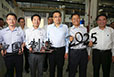
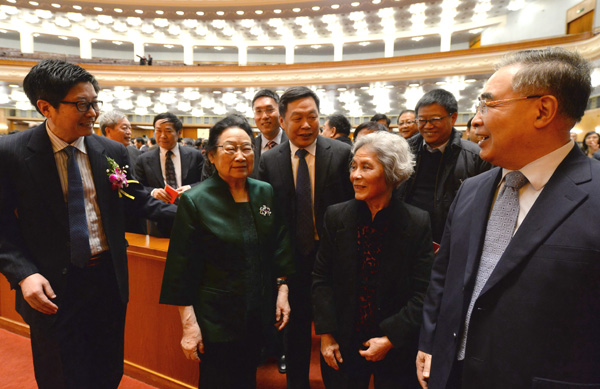
Tu Youyou (second left) receives congratulations from her research partners at the ceremony of the State Science and Technology Awards in Beijing on Monday.[Photo by ZHOU WEIHAI/FOR CHINA DAILY] |
Nobel Prize winner is best known for contribution to discovery of artemisinin
The Preeminent Science and Technology Award - the highest award in China for recognizing an individual scientist's contribution - was given to Tu Youyou.
Tu, born on Dec 30, 1930, is China's first Nobel Prize winner in physiology or medicine. She shared the prize in October 2015 with Irish William Campbell and Japanese Satoshi Omura for developing therapies against malaria and infections caused by roundworm parasites.
Many people expected Tu to be awarded the Preeminent Science and Technology Award in January 2016, but the prize remained vacant that year - the second time in history - because nominations closed a few months before Tu won the Nobel Prize and no one recommended Tu as a candidate for the preeminent award.
Critics questioned why Tu had not been given the honor she deserved - such as the title of academician, which she applied for unsuccessfully on four occasions for decades.
"Tu was depressed following a dispute over her discovery of qinghaosu (artemisinin)-a drug therapy for malaria that has saved millions of lives across the world - but after being awarded the Nobel Prize, her mental state improved," said Liao Fulong, Tu's colleague at the China Academy of Traditional Chinese Medicine.
Tu graduated in 1955 from the department of pharmaceutics at Beijing Medical College (which was renamed Beijing Medical University in 1985). She then worked for the China Academy of Traditional Chinese Medicine, now named the China Academy of Chinese Medical Sciences.
In 1969, Tu was elected chair of a government project aimed at eradicating malaria. She and her colleagues experimented with 380 extracts in 2,000 candidate recipes before they finally succeeded in obtaining the pure substance qinghaosu, which became the standard malaria treatment regimen in the World Health Organization's catalog of essential medicines.
However, as the project involved the participation of numerous people and institutes, some people questioned Tu's contribution.
Tu never won any top honors for science in China, despite winning the Albert Lasker Award - a top prize in medical science - in 2011.
"The qinghaosu research project is a collective achievement of Chinese scientists, which also represents high international recognition of traditional Chinese medicine," she said during an interview after winning the Nobel Prize.
"I do not have much to say personally. This scientific achievement is a result of teamwork," she said.

- High speed train crew ensures happy journey on the fast track
- China unveils pilot program on provincial territorial planning
- New supervisory body to share responsibility and organization with CCDI: Official
- Anti-graft agency planning to investigate suspect in SW China shooting
- 'Anti-smog tea' unhelpful: TCM expert